Many new all-grain brewers—and even some experienced ones—often ask whether it’s possible to shorten their brew day by reducing boil time. Since boiling does sterilize wort, the question usually sounds like this:
“If sterilization is the goal, can I just boil for 20–30 minutes instead of the full 60 or 90 minutes?”
The short answer:
You can shorten the boil in certain cases, but you may not get the beer you intended.
That’s because the boil stage does far more than simply kill microbes. It is one of the most critical phases in the entire brewing process. Understanding its functions will help you decide whether cutting the boil makes sense for a particular recipe—or if maintaining the traditional boil is essential.
This article explains the many roles of wort boiling, why each is important, and how TIANTAI’s brewhouse design helps you achieve ideal boil performance, efficiency, and flavor quality. Whether you’re experimenting at home or brewing on a professional scale, this guide will help you brew better beer.
What Is Wort Boiling and Why Do We Do It?
After the mash and lautering stages, brewers collect sweet wort in the kettle. This wort must be boiled before it is ready for fermentation. Although sterilization is indeed one of its functions, boiling plays a much larger role in beer production.
A proper boil:
- Stops enzymatic activity
- Concentrates wort to achieve target gravity
- Isomerizes hop alpha acids (creating bitterness)
- Enhances color through chemical reactions
- Reduces wort pH
- Drives off volatile compounds like DMS
- Promotes protein coagulation (hot break)
- Improves clarity and stability
- Helps form the correct environment for yeast health
- Enhances aroma and flavor through hop additions
These functions all require time—and the right intensity of the boil—to happen correctly.
1. Stopping Enzyme Activity: The Boil “Locks In” Your Wort Profile
During mashing, enzymes like beta-amylase, alpha-amylase, proteases, and glucanases work together to convert grain starches into fermentable sugars. But once the mash is complete, you want these enzymes to stop working.
Why stop enzyme activity?
If enzymes continue reacting:
- Your wort could become too fermentable
- Beer may finish too dry
- Body and sweetness may disappear
- The intended beer style could be lost
Most enzymes become denatured between 50–75°C, which is the reason for performing a mash-out step at around 75°C for 10 minutes. This halts enzymatic action and prepares the mash for lautering.
But the boil ensures complete enzyme denaturation.
At 100°C, no enzymatic activity remains, meaning the wort now has a stable fermentability level that will not change unexpectedly.
TIANTAI mash tuns and kettle tuns include precise heating controls, insulation, and uniform temperature distribution to ensure mash-out and boiling are performed reliably, protecting the intended wort profile.
2. Concentrating the Wort: Achieving Target Gravity
Boiling wort removes water as steam, thereby increasing the concentration of sugars. The longer and stronger the boil, the more concentrated the wort becomes.
This is crucial because:
- It affects original gravity (OG)
- Higher OG increases alcohol potential
- Gravity also impacts mouthfeel and body
Brewers must know their evaporation rate. (For example, many systems evaporate around 2.5 L per hour.)
Gravity Calculation Example
Using the formula:
pre-boil volume × pre-boil gravity = post-boil volume × post-boil gravity
Let’s say:
Pre-boil volume = 28 L
Pre-boil gravity = 1.050 (use 50 points)
Evaporation = 2.5 L per hour
Post-boil volume = 25.5 L
Now calculate:
28 × 50 = 25.5 × post-boil gravity
1400 ÷ 25.5 = 54.9 points
So the final gravity ≈ 1.055
This shows how evaporation affects wort density. Reducing boil time would lower evaporation, meaning your OG would drop—unless you adjust water or malt accordingly.
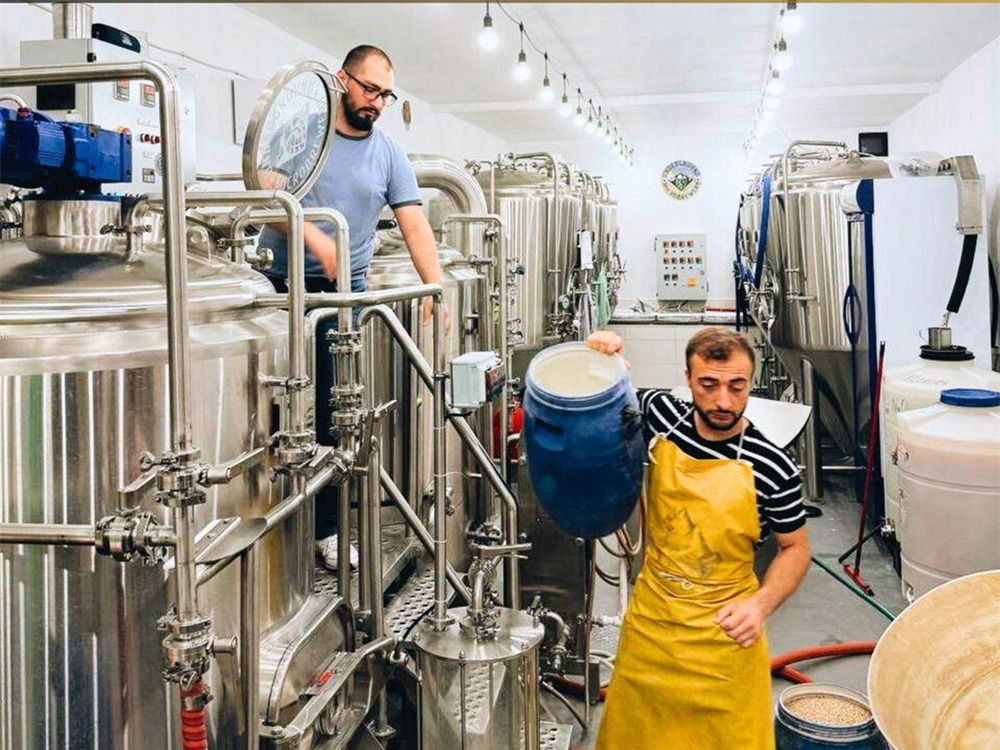
TIANTAI boiling kettles include:
High-efficiency steam jackets
Optional external boiling systems
Precision evaporation rate control
Vent and condensation systems
These ensure predictable gravity results from batch to batch.
3. Isomerization of Alpha Acids: Creating Bitterness
Hops contain alpha acids, which are not soluble in wort in their natural form. They must undergo isomerization, a chemical reaction that occurs only at boiling temperatures.
Key points about hop isomerization:
- Most isomerization happens within the first 30 minutes
- Roughly 90% of the bitterness potential is achieved by 30 minutes
- Maximum efficiency is reached around 60–70 minutes
- Boiling longer does not significantly increase bitterness
- A shorter boil can be used, but you must adjust hop utilization
So while a 30-minute boil is possible, keep in mind:
- Gravity will be lower
- Color will be lighter
- DMS reduction may be insufficient
- Aroma hop timing will change
TIANTAI kettle Tuns are designed with smooth heat movement and efficient mixing to ensure consistent hop extraction and predictable bitterness.
4.Increasing Wort Color: Chemical Reactions During Boil
Boiling wort causes several reactions that deepen color and enrich flavor:
a) Maillard Reactions
These reactions between amino acids and reducing sugars produce:
Golden or amber coloration
Caramel/toffee notes
Depth and complexity
b) Caramelization
Occurs when sugars are heated and darken:
Gives richness
Enhances malt character
Helps develop certain beer styles (bocks, stouts, strong ales)
c) Polyphenol Oxidation
Oxidation of tannins forms compounds that:
Slightly darken color
Contribute to flavor development
These reactions require time and adequate heat. Cutting the boil can lead to:
Paler wort
Weaker malt flavor
Less complexity
TIANTAI’s kettles feature optimized steam jackets and heating surfaces to give strong, even boiling for reliable color development.
5. Reduction of Wort pH: Improving Clarity, Flavor, and Yeast Health
Wort pH changes during each stage of brewing. A proper boil helps achieve ideal pH conditions for fermentation.
Typical pH targets:
Mash pH: 5.2–5.5
Pre-boil pH: 5.2–5.4
Post-boil pH: drops by ~0.1–0.2 (ideal 5.0–5.3)
Finished beer pH: 4.2–4.6
Why does pH drop during boiling?
Because calcium forms insoluble salts that precipitate out. This lower pH:
Improves hot break formation
Enhances wort clarity
Increases long-term stability
Encourages healthy yeast growth
Reduces bacterial contamination risks
Skipping or shortening the boil means losing these pH benefits.
6. Driving Off Volatile Compounds: Removing DMS and Other Off-Flavors
One of the most important functions of boiling is removing dimethyl sulfide (DMS), a compound that creates “sweet corn” or “cooked vegetable” flavors.
Where does DMS come from?
DMS forms from SMM (S-methylmethionine), naturally found in malt—especially pilsner malts.
How do we remove it?
A strong, rolling boil volatilizes DMS
Steam removes DMS from the kettle
Maintaining an open, vented boil is critical
Reducing boil time may result in:
Noticeable corn-like flavor
Off-aromas
Poor beer quality
TIANTAI kettle tuns include professional steam vent stacks and vapor management systems that efficiently remove DMS.
7. Additional Functions of the Boil
✔ Coagulation of proteins (hot break)
Creates clearer wort and improves stability.
✔ Sanitizing the wort
Boiling kills microorganisms, protecting the beer from infection.
✔ Enabling hop aroma additions
Each timing—60 minutes, 30 minutes, 10 minutes, 0 minutes, whirlpool—produces distinct aroma profiles.
✔ Preventing haze formation
Through protein precipitation.
✔ Driving faster cooling performance
Boiled wort cools more predictably because proteins and pH have been stabilized.
Can You Shorten Your Boil?
Yes—but only with caution.
Shorter boils may work for:
Low-gravity beers
Highly modified malt
Late-hop or no-hop styles (New England IPAs, fruity beers)
Small experimental batches
But traditional 60–90 minute boils are recommended for:
Lagers
Pilsners
High-adjunct mashes
High-gravity beers
Beers needing deep color or malt richness
Recipes requiring precise bitterness
If experimenting, track:
OG
Bitterness (IBUs)
pH
Flavor stability
Color
DMS levels
TIANTAI brewhouse systems allow full control of boil time, heat intensity, hop dosing timing, and evaporation rate, making experimentation easier and repeatable.
TIANTAI Brewery Equipment: Designed for Optimal Wort Boiling
TIANTAI specializes in turnkey microbreweries, craft breweries, and commercial brewhouses, providing complete brewhouse and cellar solutions.
Our brewing kettles offer:
Efficient steam or electric heating
Multi-layered insulation
Uniform heat distribution
Intelligent control systems
Professional-grade steam vent stack
Optional external wort boilers
High evaporation efficiency
Precision hop addition automation
We customize every system to your recipe needs—whether you prefer short experimental boils or traditional long boils.
Wort Boiling Deserves More Attention Than It Gets
While it’s tempting to shorten the brew day, the wort boil performs far too many essential functions to dismiss. From flavor development and bitterness creation to pH adjustment, sanitation, color formation, and clarity improvement, the boil profoundly shapes your final beer.
Experimenting is part of brewing—but understanding the science behind the boil ensures your experiments lead to great results.
TIANTAI Brewery Equipment is here to support your brewing success with professional brewhouse design, high-quality kettles, fermentation tanks, and complete turnkey systems.
If you’re planning a new brewery or upgrading your brewhouse, we warmly welcome your proposal.
Edited By Daisy
[email protected]