Dans les secteurs des boissons, de l'alimentation, de l'agriculture et de la pharmacie, le broyage est l'une des étapes de traitement les plus essentielles. Qu'il s'agisse de concasser du malt pour le brassage, de broyer des céréales pour l'alimentation animale ou de traiter des matières sèches pour la fabrication, un défi est presque universel : la poussière.
La poussière générée pendant le broyage peut sembler un inconvénient mineur à première vue. Cependant, la poussière accumulée peut avoir un impact négatif sur la qualité des produits, la sécurité des travailleurs, la durée de vie des équipements et l'efficacité globale de la production. Ces dernières années, de plus en plus d'entreprises ont pris conscience de l'importance d'investir dans des systèmes de dépoussiérage appropriés pour leurs opérations de broyage.
Dans cet article, nous verrons pourquoi le dépoussiérage est important, comment fonctionnent les systèmes de dépoussiérage modernes, quels sont les types disponibles et comment le choix de la bonne solution peut transformer votre environnement de production.
Pourquoi le dépoussiérage est-il important ?
- Amélioration de la qualité des produits
L'excès de poussière ne crée pas seulement un espace de travail désordonné, il peut aussi compromettre la qualité du produit final. Par exemple, dans les brasseries, une trop grande quantité de poussière de grain en suspension dans l'air peut contaminer les ingrédients ou altérer la consistance de la mouture. Dans d'autres industries, la poussière peut se mélanger aux produits finis, entraînant des incohérences et des impuretés.
Un système de dépoussiérage adéquat permet de maintenir un processus de production propre et stable et de garantir que votre produit répond aux normes les plus strictes.
- De meilleures conditions de travail et de sécurité
Les poussières de broyage peuvent facilement être mises en suspension dans l'air et inhalées par les travailleurs. Une exposition prolongée peut entraîner une gêne respiratoire ou des problèmes de santé. En outre, les fines particules de poussière en suspension dans l'air peuvent créer des problèmes de visibilité et augmenter la charge de travail liée au nettoyage.
Plus important encore, dans certains environnements, l'accumulation de poussière peut même présenter des risques d'explosion. Bien que de nombreuses opérations de transformation des aliments et de brassage soient considérées comme peu risquées, il est toujours essentiel de minimiser la concentration de poussière pour des raisons de sécurité et de conformité avec les réglementations sur le lieu de travail.
- Réduction de l'usure des équipements
La poussière qui se dépose sur les composants des machines peut provoquer des frottements, des surchauffes ou des colmatages. Au fil du temps, cela augmente les besoins de maintenance et peut raccourcir la durée de vie de votre usine ou de votre équipement connexe. Les systèmes de dépoussiérage contribuent à protéger votre investissement en maintenant les machines plus propres et en assurant un fonctionnement plus régulier.
- Efficacité opérationnelle accrue
Une zone de production propre contribue à un flux de travail plus fluide, à moins d'arrêts et à une production plus régulière. Les systèmes de dépoussiérage stabilisent le flux d'air à l'intérieur du broyeur, ce qui garantit que les matériaux broyés sont transportés efficacement sans colmatage ni répartition inégale.
Fonctionnement des systèmes de dépoussiérage
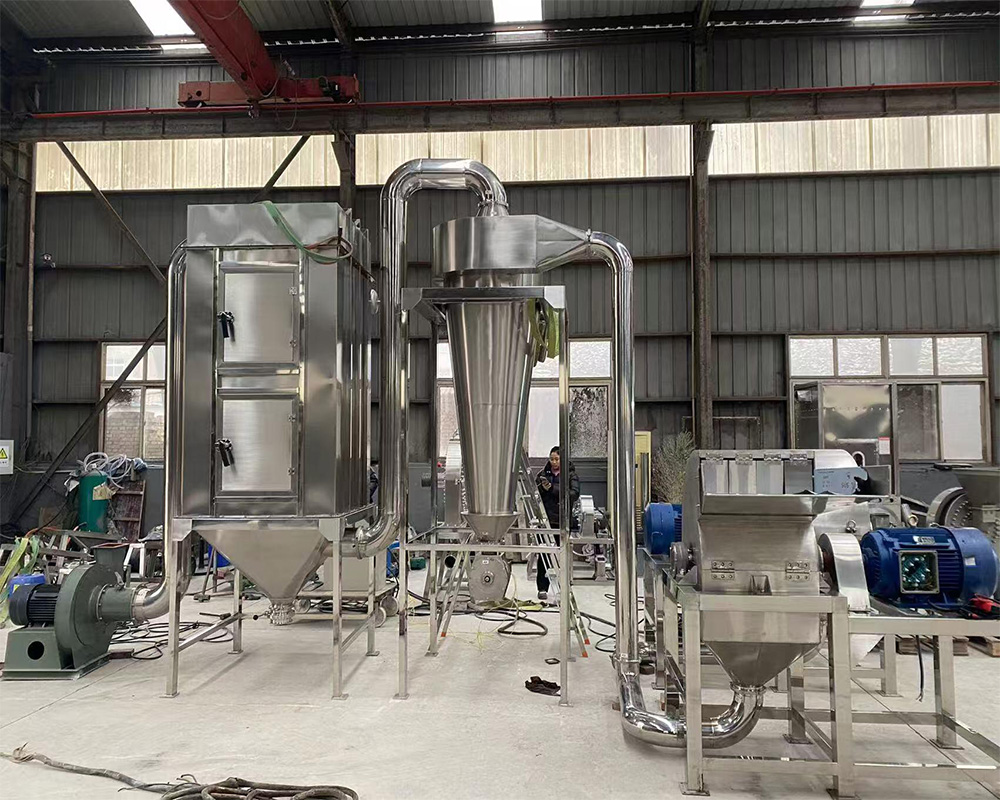
Les systèmes modernes de dépoussiérage sont conçus pour capturer la poussière à la source, la filtrer et rejeter de l'air propre dans l'espace de travail.
Un système standard comprend généralement
Hotte anti-poussière ou chambre de broyage fermée
Placé à proximité des rouleaux ou des lames de broyage, il capte les poussières dès leur formation.
Conduits d'air / tuyaux d'aspiration
Ils transportent les poussières et les particules fines du broyeur vers une unité de filtration.
Dépoussiéreur (unité de filtration ou cyclone)
C'est le cœur du système. Les modèles les plus courants sont les cyclones, les filtres à poches et les filtres à cartouches, chacun offrant des niveaux d'efficacité variables.
Ventilateur ou soufflerie
Crée une pression négative qui éloigne la poussière du broyeur et l'amène dans le collecteur.
Récipient d'évacuation des poussières
Recueille les poussières filtrées pour les éliminer ou les réutiliser en toute sécurité.
Ensemble, ces composants garantissent que la poussière est continuellement éliminée, filtrée et confinée, ce qui l'empêche de se répandre dans l'espace de travail.
Types courants de systèmes de dépoussiérage
- Dépoussiéreurs cycloniques
Les systèmes cycloniques utilisent la force centrifuge pour séparer les particules de poussière de l'air. Ils sont simples, durables et rentables, ce qui les rend idéaux pour les brasseries, les usines d'aliments pour animaux et la transformation des produits agricoles.
Avantages
Peu d'entretien
Convient pour les particules de grande taille
Bonne circulation de l'air et durabilité
Limites
Ne convient pas pour les poussières ultrafines, à moins d'être associé à un filtre secondaire.
- Dépoussiéreurs à sacs filtrants
Ces systèmes utilisent des sacs filtrants en tissu pour piéger les fines particules de poussière. L'air passe à travers les sacs tandis que la poussière s'accumule à la surface.
Avantages :
Efficacité élevée de captage des poussières
Bon pour les particules fines
Largement utilisé dans les industries alimentaires et chimiques
Limites :
Nécessite un nettoyage régulier et le remplacement des sacs
- Systèmes de filtres à cartouches
Les filtres à cartouche assurent un dépoussiérage à haute efficacité grâce à des éléments filtrants plissés. Ils sont compacts et conviennent aux opérations dans un espace limité.
Avantages :
Capture des particules extrêmement fines
Conception compacte
Entretien facile
Limites :
Investissement initial plus élevé
- Systèmes de broyage fermés avec dépoussiérage intégré
Certains broyeurs modernes sont entièrement fermés et équipés de systèmes de dépoussiérage intégrés. Ces unités conviennent aux petites et moyennes entreprises qui ont besoin d'une solution compacte et tout-en-un.
Comment choisir le bon système de dépoussiérage ?
- Tenez compte du type de matériau que vous fraisez
La poussière de céréales se comporte différemment de la poussière de bois ou de la poudre pharmaceutique. La taille des particules et le taux d'humidité influencent le type de dépoussiéreur nécessaire.
- Évaluer l'ampleur de votre production
Les broyeurs de grande capacité génèrent plus de poussière et nécessitent une plus grande puissance d'aspiration et des unités de filtration plus grandes.
- Évaluez votre espace et votre disposition
Les espaces limités peuvent nécessiter des solutions compactes ou murales, tandis que les installations plus grandes peuvent intégrer des systèmes centralisés plus importants.
- Tenir compte des coûts de maintenance et d'exploitation
Choisissez un système que votre équipe peut facilement gérer en termes de nettoyage, de remplacement des filtres et d'entretien de routine.
- Priorité à la sécurité et à la conformité
Veillez à ce que votre système soit conforme aux normes de sécurité locales, en particulier si votre environnement comporte des poussières combustibles.
Avantages de l'investissement dans un bon système de dépoussiérage
✔ Un environnement plus propre et plus sûr
Votre équipe travaille plus confortablement et en toute sécurité.
✔ Meilleure qualité des produits
Moins de contamination et des performances de broyage plus constantes.
✔ Coûts de maintenance réduits
L'équipement reste plus propre, ce qui réduit l'usure et prolonge la durée de vie.
✔ Une meilleure efficacité
Réduction des temps d'arrêt et fonctionnement plus souple.
Image professionnelle améliorée
Une installation propre et contrôlée reflète le professionnalisme et renforce la confiance des clients, ce qui est particulièrement important pour les brasseries et les fabricants de produits alimentaires qui accueillent des visiteurs.
Conclusion : Le contrôle des poussières est un investissement, pas un coût
Le dépoussiérage est souvent négligé dans les opérations de broyage, mais il joue un rôle crucial en matière de sécurité, de qualité et d'efficacité. Que vous dirigiez une brasserie, une usine d'aliments pour animaux ou une usine de fabrication, l'installation d'un système de dépoussiérage adéquat est l'un des investissements les plus judicieux que vous puissiez faire.
Les systèmes modernes de dépoussiérage sont plus efficaces, plus fiables et plus faciles à entretenir que jamais. En choisissant la bonne solution, vous protégez non seulement vos travailleurs et votre équipement, mais vous améliorez également vos performances de production globales.
Si vous avez besoin d'aide pour choisir une solution de dépoussiérage ou si vous souhaitez explorer les équipements de broyage dotés d'options intégrées de contrôle des poussières, n'hésitez pas à nous contacter. Nous sommes toujours prêts à vous recommander un système adapté aux besoins de votre installation.
Merci pour votre lecture.
Hélène