Ginger beer is a naturally flavored, carbonated beverage made from ginger root, sugar, water, and citrus, with fermentation providing natural fizz and a touch of alcohol (typically <1% ABV). Depending on production goals, it can be brewed using natural fermentation or controlled carbonation.
1.Raw Materials
It includes Fresh ginger root (or ginger extract),Sugar (sucrose, glucose, or molasses),Lemon or lime juice,Water,Yeast (Saccharomyces cerevisiae or similar).
2.Wort Preparation
Ginger Extraction
Fresh ginger is washed, grated, or crushed.
Heated in water (~90°C) for 10–15 minutes to extract flavor and aroma compounds (gingerols, shogaols).
The mixture is filtered to remove solids.
Sugar Addition
Sugar is dissolved into the hot ginger extract to reach the desired gravity (e.g., 1.030–1.045 SG for light ginger beer).
Stir until fully dissolved.
Acid and Flavor Adjustment
Add lemon juice or citric acid to balance pH (target pH 3.5–4.2).
Additional flavoring ingredients can be added at this stage (e.g., lime peel, lemongrass).
Cooling
Cool the mixture to yeast pitching temperature (20–25°C for ale yeast).
3.Fermentation
Transfer the cooled liquid to a sanitized fermenter.
Pitch yeast (around 0.5–1 g/L for commercial scale).
Ferment at 20–25°C for 2–4 days, depending on the desired sweetness and carbonation.
Monitor gravity and taste daily.
When residual sugar and carbonation reach target levels, cold crash (chill to ~2–4°C) to stop fermentation.
Note: For non-alcoholic ginger beer, fermentation is either prevented (by pasteurization or filtration) or replaced with forced carbonation.
4.Clarification and Filtration
After fermentation:
Remove yeast and solids by filtration or centrifugation.
For naturally cloudy ginger beer, minimal filtration can retain a rustic appearance.
Adjust sweetness if needed with back-sweetening using sugar or syrup (must be pasteurized or stabilized if product remains unpasteurized).
5.Carbonation
Two main methods:
a.Natural Carbonation
Bottle or keg the beer while a small amount of sugar or fermentable extract remains.
Seal and allow secondary fermentation for 1–2 days at room temperature, then refrigerate.
Used in traditional or craft-style production.
b.Forced Carbonation
Chill the filtered ginger beer and inject CO₂ under pressure (2–3 volumes of CO₂ typical).
Used in commercial production for consistent results.
6.Packaging
Fill into glass bottles, cans, or kegs.
If naturally fermented, use pressure-resistant bottles (e.g., swing-top).
Pasteurize (typically 60–70°C for 15–20 min) or cold-filter to stabilize shelf life.
Summary Flow:
Ginger Preparation → Boil with Sugar → Cool → Add Yeast → Ferment → Filter → Carbonate → Bottle → Chill
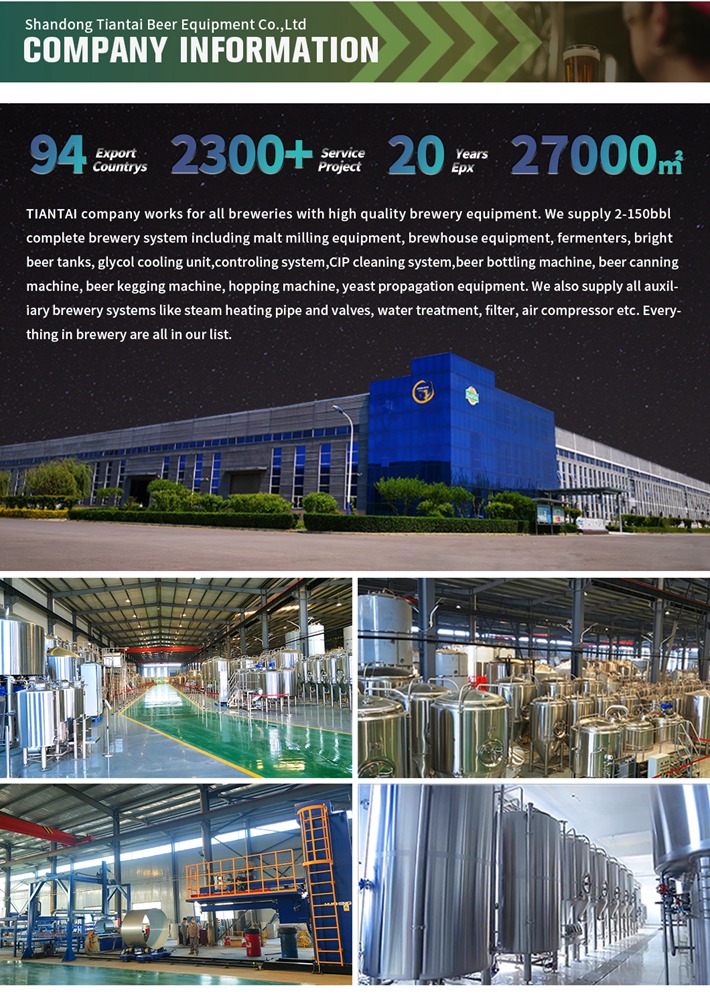
TIANTAI company can provide you various distillery ,offer innovative solutions and cutting-edge technology to help you achieve your brewing dreams. With Tiantai you can trust that your brewery project will be in expert hands from start to finish. As a general contractor, Tiantai supplies turnkey solutions for the entire brewery. We manufacture precisely matched brewery systems developed according to energy and economic aspects. With our decades-long experience in integrative systems construction, we have successfully completed a multitude of turnkey projects all around the globe.
Helen Lee
Sales Manager
[email protected]