Introduction to 4T/h Wort Automatic Filter Press in Beer Wort Filtration
In modern breweries, achieving high brewhouse efficiency, consistent wort clarity, and stable production capacity is essential for maintaining both product quality and operational competitiveness. As the global brewing industry continues to evolve, more breweries—especially medium to large-scale facilities—are turning to advanced filtration technologies to replace or supplement traditional lautering systems. Among these technologies, the Wort Automatic Filter Press stands out as one of the most efficient and innovative solutions for wort separation.
A wort automatic filter press is a fully automated, high-precision solid–liquid separation system designed to extract the maximum amount of clear wort from the mash. Unlike the conventional lauter tun, which relies on natural grain bed formation and can be sensitive to malt quality variations, a filter press uses a series of chambers lined with filter cloths to mechanically separate the wort from spent grains. This approach provides exceptional performance in terms of filtration speed, extract recovery, wort brightness, and operational reliability.
One of the key advantages of the automatic filter press is its high extract yield. By applying controlled pressure to the mash, the system can squeeze out significantly more wort compared to traditional methods. This not only increases brewhouse efficiency but also helps reduce production costs by maximizing the use of raw materials. Brewers typically see improvements of 2–5% in extract recovery, which can translate to substantial savings over time.
Another major benefit is process consistency and clarity of wort. With uniform filtration plates and stable pressure control, the wort produced is exceptionally bright, often reaching turbidity levels below 10 EBC. This results in cleaner fermentation, improved flavor stability, and fewer issues downstream in the brewing process. The automated nature of the system ensures repeatability between batches, reducing the variability associated with operator experience or malt quality differences.
The automatic filter press also offers significant time savings. A standard filtration cycle is much faster than a full lautering process, allowing breweries to shorten their brew day, increase the number of brews per day, or expand their annual production capacity without adding additional brewhouse vessels. The automation features—such as automatic squeezing, cake discharge, and cleaning cycles—minimize manual labor and reduce the risk of human error.
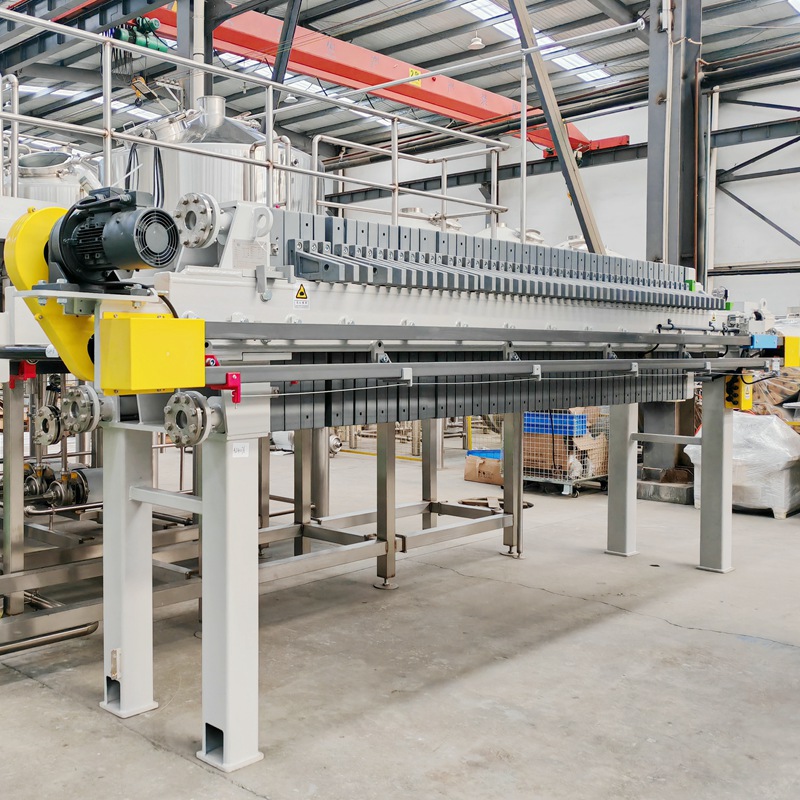
Scope of supply for filter press for each filter press
Automatic membrane filter press
| NO | NAME | MODEL | Qty | REMARKS |
| 1. | Filter press Frame | TT80-1000-UK | 1 | Carbon Steel with Sandblasting and paint primer and acrylic polyurethane finish |
| 2. | Membrane plate | 1000x1000x72 | 25 | Reinforce PP+TPE, gaskted type, with Silicone rubber ring |
| 3. | Recessed plate | 1000x1000x63 | 24 | Reinforce PP, with Silicone rubber ring |
| 4. | Head plate | 1000×1000 | 1 | Reinforce PP ,with Silicone rubber ring |
| 5. | Tail plate | 1000×1000 | 1 | Reinforce PP,with Silicone rubber ring |
| 6. | Filter cloth | 1000×1000 | 50 | Made by Jingjin Germany production line
Heat setting, calendaring treatment, cut by laser |
| 7. | Auto Control cabinet | Matching | 1 | PLC: Siemens |
| 8. | Automatic hydraulic system | Matching | 1set | Cylinder:27SIMn seamless steel pipe
Piston rod: 45# steel and clad with 0.06 chromium Processed by mid frequency induction hardening |
| 9. | Automatic plate shifting system | Matching | 1set | Automatic plates shifted one by one
Frequency convertor AB |
| 10. | Squeeze manifold | Matching | 1 set | Material:SS 304 |
Technical parameter list
| Model | TT80-1000-UK |
| Quantity | 1 Set |
| Compressing type | Automatic hydraulic System |
| Plate Shifting type | Automatic plate shifted one by one |
| Feeding type | Single feeding and center feeding |
| Filtration area | 80㎡ |
| Chamber Qty | 50 |
| Chamber volume | ~1.36m³ |
| Cake thickness | 34mm |
| Plate type | Recessed and membrane mixed plates,gasketed type |
| Filtrate discharge way | closed type |
| filter plate size | 1000×1000×72/63mm |
| Feeding pressure | <0.8Mpa |
| Squeezing pressure | <1.0Mpa |
| Working pressure of oil cylinder | ≤25Mpa |
| Operating temperature | 85℃ |
From an environmental standpoint, the system is highly efficient. Spent grains discharged from the filter press are relatively dry and easy to handle, reducing storage and transportation costs. The lower water consumption compared to traditional lautering also supports sustainable brewing practices, a growing priority for breweries worldwide.
In summary, the Wort Automatic Filter Press represents a modern, high-performance approach to wort separation. With its outstanding extract recovery, faster filtration time, improved wort clarity, and automation features, it provides breweries with a reliable and scalable solution for enhancing brewhouse productivity. Whether used as a primary filtration method or as an upgrade to existing systems, the automatic filter press is an investment that supports both quality improvement and long-term operational efficiency in today’s competitive brewing industry.