Designing an efficient fermentation tank piping layout is essential for achieving hygienic production, stable beer quality, and smooth brewery operation. A well-designed piping system ensures proper flow of beer, CO₂, cleaning chemicals, and cooling media while minimizing contamination risks and operational complexity.
Whether building a craft brewery or a large-scale industrial plant, the piping layout should be planned carefully to balance efficiency, hygiene, flexibility, and future expansion.
This article explains key design principles, typical pipeline configurations, and best practices for fermentation tank piping systems.
1. Understand the Process Requirements
Before designing the piping layout, it is important to identify all process functions connected to fermentation tanks.
Typical process connections include:
Product pipelines
*Wort inlet pipeline
*Beer transfer pipeline
*Yeast pitching line
*Sampling line
Utility pipelines
*CO₂ supply pipeline
*Sterile air pipeline
*Glycol cooling pipeline
*CIP cleaning pipeline
Control and safety connections
*Pressure relief valve
*Vacuum valve
*Temperature sensor port
*Pressure gauge
Understanding the full process ensures that no necessary connection is overlooked during design.
2. Basic Configuration of Fermentation Tank Piping
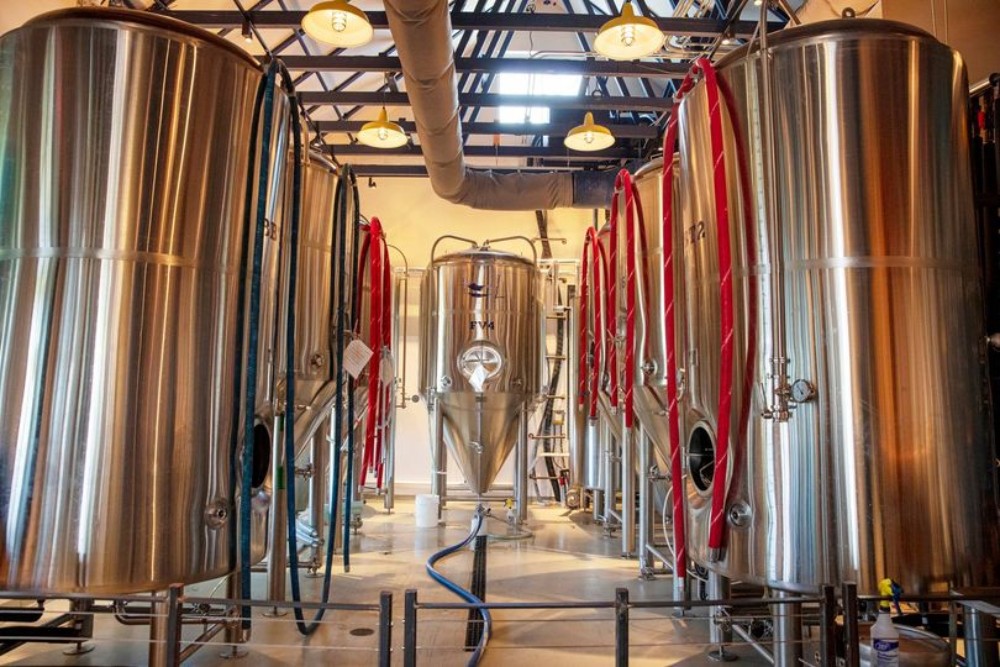
Most brewery fermentation tanks use conical bottom fermenters, and the piping layout is usually divided into three zones:
Top connections
Located on the tank top head:
♦CIP spray ball connection
♦CO₂ exhaust pipe
♦Pressure safety valve
♦Vacuum breaker
♦Dry hopping port
♦Level sensor
♦Side connections
Located on the cylindrical body:
♦Temperature sensor port
♦Sampling valve
♦Carbonation stone port (optional)
♦Racking arm connection
♦Bottom connections
Located on the cone bottom:
♦Beer outlet pipeline
♦Yeast discharge pipeline
♦CIP return pipeline
Proper placement ensures complete draining and easy cleaning.
3. Manifold Design for Multiple Fermentation Tanks
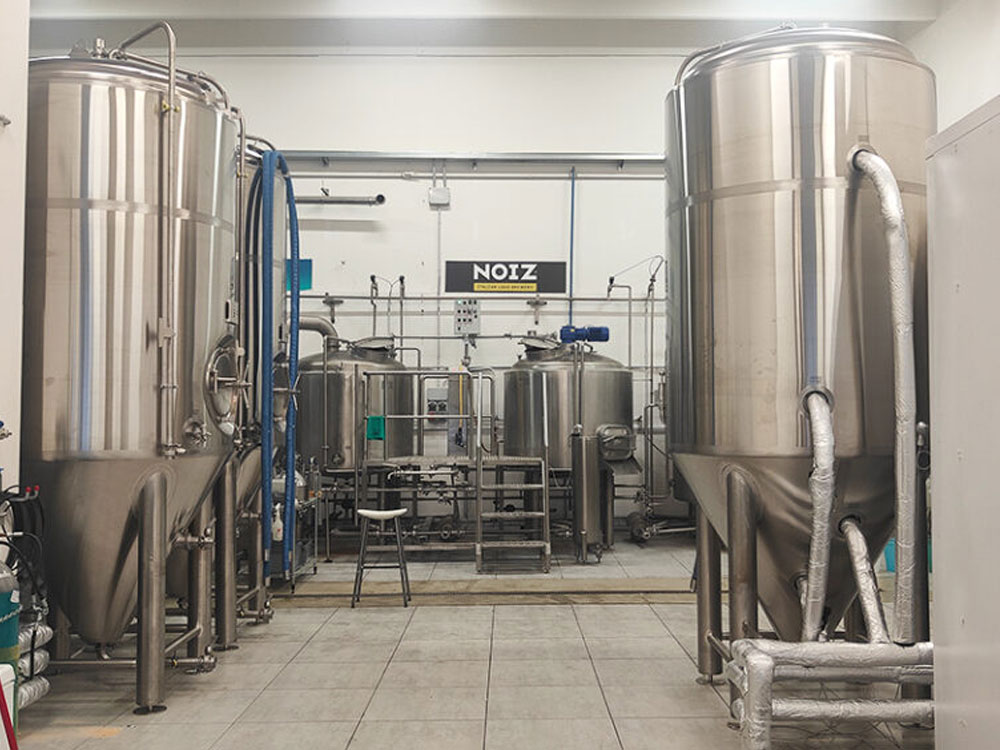
When multiple fermentation tanks are installed, manifold piping is recommended to improve efficiency.
A typical manifold connects several tanks to shared pipelines for:
Beer transfer ⇒ CIP supply and return ⇒ CO₂ distribution ⇒ Sterile air supply
Advantages of manifold design:
♦Reduced piping complexity
♦Centralized valve control
♦Easier operation
♦Reduced contamination risk
♦Space-saving layout
Each tank should have independent valves to ensure process flexibility.
4. Hygienic Design Principles
Hygiene is the most important consideration in brewery piping design.
Key hygienic requirements:
- Avoid dead legs. Dead legs are pipe sections where liquid does not flow properly. These areas may harbor bacteria and contamination.
- Recommended guideline: Dead leg length should be less than 1.5 times the pipe diameter.
- Smooth internal surface.Use polished stainless steel pipelines (Ra ≤ 0.8 μm) to reduce microbial adhesion.
- Drainability. All pipelines should be designed with proper slope to allow complete drainage.
Typical slope:
1–2% inclination.
Use sanitary fittings
Common sanitary connections include:
*Tri-clamp fittings
*Hygienic valves
*Orbital welding joints
5. Pipe Diameter Selection
Proper pipe diameter ensures stable flow and avoids excessive pressure loss.
Typical recommendations:
| Pipeline Type | Recommended Diameter |
| Wort inlet | DN32–DN40 |
| Beer transfer | DN32–DN50 |
| CIP supply | DN40–DN50 |
| CO₂ line | DN15–DN25 |
| Yeast discharge | DN25–DN32 |
Pipe sizing depends on:
–Tank volume
–Flow rate requirement
–Pump capacity
–Cleaning velocity requirements
Proper flow velocity for CIP is typically 1.5–2.5 m/s.
6. Valve Configuration
Valves control flow direction, pressure, and isolation.
Common valve types used in fermentation tank piping:
Butterfly valves
Most widely used due to simple structure and low cost.
Diaphragm valves
Preferred in high hygienic requirements.
Ball valves
Used in utility lines.
Check valves
Prevent backflow contamination.
Automatic valves can be integrated with PLC systems for process automation.
7. CIP Integration
Fermentation tanks must be designed for efficient CIP cleaning.
Typical CIP connections include:
♦CIP supply line at tank top
♦Spray ball for internal cleaning
♦CIP return line at tank bottom
CIP design considerations:
♦Ensure sufficient flow rate
♦Avoid shadow areas inside tank
♦Ensure full coverage of spray ball
♦Allow independent cleaning of each tank
Centralized CIP systems can clean multiple tanks sequentially.
8. CO₂ and Pressure Control Piping
Fermentation produces CO₂ gas, requiring proper gas management pipelines.
Typical CO₂ piping functions:
♦CO₂ exhaust during fermentation
♦CO₂ supply for tank purging
♦Pressure stabilization
♦Carbonation (optional)
Install pressure relief valves and vacuum valves to protect tank safety.
Pressure gauges should be installed for monitoring.
9. Layout Planning for Brewery Space Optimization
Piping layout should consider:
♦Operator accessibility
♦Maintenance convenience
♦Safety clearance
♦Future expansion
Best practices include:
♦Install manifolds near tank groups
♦Keep pipelines organized and labeled
♦Avoid complex cross piping
♦Allow space for additional tanks
Good layout improves workflow efficiency and plant appearance.
10. Material Selection
Most brewery fermentation piping uses:
Stainless Steel 304 ⇒ Suitable for most beer production environments.
Stainless Steel 316L ⇒Recommended for: Sour beer production/ Kombucha production/ High acidity environments/ High chloride water conditions
Both materials provide durability and hygienic performance.
11. Typical Fermentation Tank Piping Diagram
A standard piping layout usually includes:
Wort inlet pipeline
Beer transfer pipeline
Yeast discharge pipeline
CIP supply and return
CO₂ pipeline
Пробоотборный клапан
Манометр
Датчик температуры
Предохранительный клапан
Professional engineering drawings help ensure proper installation and operation.
Designing fermentation tank piping layout requires balancing hygiene, efficiency, automation, and cost considerations.
A well-designed piping system offers: Stable beer quality ⇒ Easy cleaning and maintenance ⇒ Reduced contamination risk⇒ Flexible production scheduling⇒Scalable brewery expansion
Careful planning at the early stage of brewery design can significantly improve long-term production performance and reduce operational problems.
Под редакцией Дейзи
[email protected]