In modern craft brewing, one of the biggest challenges is how to infuse aroma-rich hop character into beer without sacrificing product quality, yield, or efficiency. Dry hopping is the classic technique, but as breweries scale up—10 bbl, 20 bbl, 50 bbl, 100 bbl systems—the challenges multiply: oxygen pickup, uneven extraction, clogged racking arms, hop burn, and massive product losses.
This is where the Hop Gun (also called a hop cannon, hop doser, or hop suspension vessel) becomes an essential tool for many breweries. A Hop Gun dramatically improves the way hops are introduced into beer, ensuring enhanced aroma extraction, reduced losses, better flavor stability, and a more controlled dry-hop process.
This article dives deep into how a Hop Gun works, the technical design, its advantages for fermentation and cold-side brewing, and why more breweries are investing in this equipment.
1. What Is a Hop Gun?
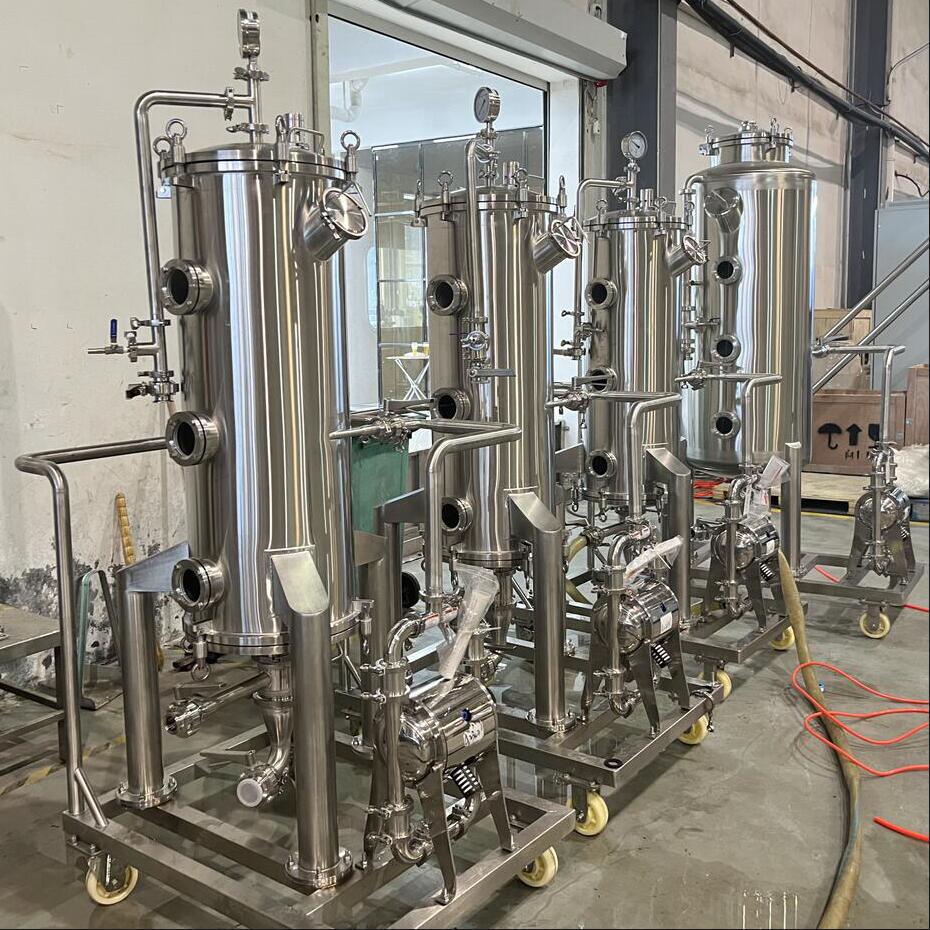
A Hop Gun is a pressurized, stainless steel hop dosing and extraction vessel used not only to add hops during fermentation or conditioning but also to maximize hop oil extraction by forcing beer through tightly suspended hops. It provides a closed-loop, oxygen-free method to introduce hop flavor and aroma into beer.
Whereas traditional dry hopping simply drops loose hops into the fermenter, a Hop Gun: keeps everything oxygen-free; circulates beer through the hops using a pump or circulation loop; keeps hop particles in suspension for superior extraction; avoids tank blockages thanks to its internal screen or whirl-flow technology; allows hop charges to be added on the cold side, even in carbonated beer; improves yield and reduces beer losses.
Hop Guns originated in German breweries as “Aromahopfen-Geschütz,” and today they are widely used by large and mid-size craft breweries that want better control and higher efficiency from their dry hopping program.
2. How Does a Hop Gun Work?
Although manufacturers vary slightly in design, the basic process is the same.
Step-by-Step Hop Gun Operation
(1). Purge the Hop Gun: Oxygen is the enemy of cold-side beer. The hop gun is filled with hops and then purged with CO₂ until it reaches oxygen-free conditions.
(2). Pressurize the Vessel: Once purged, the Hop Gun is brought to the same pressure as the fermenter, usually 10–15 psi (0.7–1 bar) or whatever is required for circulation.
(3). Begin the Recirculation Loop: A pump draws beer from the fermenter, pushes it into the Hop Gun, through the hops, and then returns the hop-infused beer to the tank.
Modern Hop Guns have: Tangential inlets to create a whirl effect that keeps hops moving; Internal screens or hop baskets to prevent hop debris from clogging the pump; High-flow circulation pumps to keep extraction active but gentle
(4). Maintain Optimal Contact Time: Most breweries run hop circulation for 15–90 minutes, repeating if needed. The Hop Gun can also sit static afterward to allow further extraction.
(5). Return Beer and Remove Hop Slurry: Once the desired aroma is reached, the remaining hop material is removed from the Hop Gun, not the fermenter. This means: better yield, less mess, fewer losses, no hop cone at the bottom of the tank blocking the outlet.
3. Functional Advantages of Using a Hop Gun
A Hop Gun does not simply make dry hopping easier; it makes it better. Here are the top advantages breweries experience.
3.1 Superior Aroma Extraction (Better Than Traditional Dry Hopping)
Loose dry hopping relies on passive diffusion. This works for small tanks but becomes highly inefficient in tanks larger than 10–20 bbl. The Hop Gun instead provides: continuous recirculation, turbulence that maximizes hop oil dissolution, uniform contact of beer with hop material. The result is stronger, brighter, and more consistent hop aroma with fewer hops used.
Some breweries report 15–30% less hop usage for the same aroma intensity.
3.2 Dramatically Lower Oxygen Pickup
Manual dry hopping requires opening the fermenter to add hops—this is how dissolved oxygen (DO) sneaks into the beer, causing: oxidation, “cardboard” flavor, muted hops, poor shelf stability. A Hop Gun eliminates this because the whole process—adding hops, purging, and dosing—is fully closed and CO₂-protected. This is especially important for export beers and breweries aiming for shelf-stable NEIPAs or IPA-focused brands.
3.3 Prevents Blockages and Reduces Beer Loss
For NEIPAs, DIPAs, and hop-heavy beers, fermenter outlets often clog due to: hop pellets, swollen hop material, trub, yeast cakes. A Hop Gun prevents this by: keeping hop solids out of the fermenter, containing hop matter in the Hop Gun vessel, circulating filtered beer back into the fermenter. This increases yield significantly. Some breweries save 5–10% of their final volume by avoiding dry hop losses.
3.4 Faster Extraction Time
Traditional dry hopping requires: 3–7 days in the tank, plus additional days for hops to settle. A Hop Gun can extract aroma in hours, not days. Many breweries complete a full hop run in 90–180 minutes, then allow beer to rest only 6–12 hours before the next step. This reduces tank residence time and increases tank turnover efficiency.
3.5 Use with Carbonated Beer or At Cold Temperatures
Traditional dry hopping must be done before carbonation and usually while fermentation is still active. A Hop Gun allows hops to be added to: cold beer, carbonated beer, finished beer, beer in brite tanks. Because no oxygen enters the system, breweries have much more flexibility.
3.6 Improved Flavor Stability
By maintaining a fully closed system, minimizing DO, and improving extraction efficiency, Hop Guns help create beer that: stays fresh longer, maintains its hop character, resists oxidation, travels better in export markets. This is especially crucial for breweries aiming to distribute widely.

4. Technical Specifications of a Hop Gun
Below are typical specifications for a commercial Hop Gun from manufacturers from Tiantai beer equipment company.
4.1 Vessel Material & Construction
Stainless steel 304 or 316L
Food-grade rotary welding
Mirror-polished internal finish
Conical bottom for hop slurry removal
Pressure-rated up to 2–3 bar (29–43 psi)
4.2 Typical Sizes
| Brewhouse Size | Hop Gun Volume |
| 5–10 bbl | 30–80 L |
| 15–30 bbl | 80–150 L |
| 50 bbl | 150–300 L |
| 100+ bbl | 300–500+ L |
Designed to hold hop pellets, whole hops, fruit, herbs, or specialty ingredients.
4.3 Sight Glass & CIP Features
CIP spray ball for full cleaning
Pressure-rated sight glass
Tri-clamp hop loading port
Pressure relief valve
Sample valve
4.4 Flow and Circulation Design
Most Hop Guns include:
♦Tangential inlet to create a whirlpool inside the vessel
♦High-flow outlet screen to prevent hop particles from escaping
♦Large-diameter piping to accommodate hop slurry
♦Sanitary centrifugal pump
♦Recirculation rate is typically 1–4 bbl/min, depending on batch size.
4.5 Oxygen Protection Systems
CO₂ purge port
Манометр
Carb stone (optional)
CO₂ head pressure up to 1–2 bar
4.6 Temperature Control (Optional)
Some designs include: Glycol jacket to maintain cold temperatures. Insulation to maintain temperature stability
4.7 Automation Options
High-end systems may include: Automated DO sensors, Pressure equalizing valves, Automated hop addition hoppers, Programmable pump cycles, HMI touch panel control
5. Why Use a Hop Gun When Beer Is in the Fermenter?
This is the core question many brewers ask: If you can dry hop directly into the tank, why invest in a Hop Gun?
Here’s the complete list of reasons.
5.1 Zero Oxygen Risk During Dry Hopping
Opening the manway or dry hop port always risks DO contamination. A Hop Gun keeps the system completely sealed.
5.2 Ideal for Large Fermenters
In 30–200 bbl tanks, dry hop pellets: clump, form layers, compact against the cone, never fully extract. A Hop Gun ensures complete, active mixing regardless of tank size.
5.3 More Efficient Use of Hops
Because extraction is faster and more thorough, breweries can: reduce hop load by 10–30%, achieve the same aroma with fewer hops, save money on high-demand hop varieties. For breweries making hop-heavy beers, this quickly pays for the equipment.
5.4 Reduced Beer Losses and Higher Final Yield
Hop material absorbs beer—often several bbl worth on large batches. Since hops stay inside the Hop Gun: yeast cone remains clean, outlets stay clear, less beer gets sucked into waste drains. This increases production efficiency.
5.5 Consistency Across Batches
Loose dry hopping is inconsistent due to: varying tank geometry, different yeast crop sizes, uneven hop dispersion. The Hop Gun process creates repeatable, controlled results.
5.6 Lower Risk of Diacetyl & Hop Creep
Traditional dry hopping can restart yeast activity (“hop creep”), causing: diacetyl spikes, refermentation, overcarbonation in packaging. By reducing contact time and controlling conditions, Hop Guns minimize this risk.
5.7 Allows Creative Infusions
Beyond hops, a Hop Gun can infuse: coffee, cacao nibs, vanilla, fruit, spices, botanicals, citrus zest, wood chips, coconut, herbs. The Hop Gun becomes a multifunctional “flavor infusion chamber.”
6. Is a Hop Gun Right for Your Brewery?
A Hop Gun is most beneficial for:
• Breweries making hop-forward beer styles→IPA, NEIPA, Double/Triple IPA, Pale ale, Dry-hopped lagers, Hazy pale ales.
• Breweries with tanks larger than 10–20 bbl→Extraction becomes inefficient without forced circulation.
• Breweries looking to reduce oxygen pickup→Especially important for breweries shipping beer long distances.
• Breweries seeking higher yield→Less hop waste = more beer sold.
• Professional production-focused breweries→Where consistency, efficiency, and stability matter.
7. Hop Gun vs. Traditional Dry Hopping: A Summary Comparison
| Характеристика | Traditional Dry Hopping | Хмельной пистолет |
| Oxygen exposure | Высокий | Zero |
| Extraction efficiency | Medium–low | Высокий |
| Extraction time | 3–7 days | 1–3 hours |
| Beer losses | Высокий | Низкий |
| Risk of clogging | Высокий | Very low |
| Oxidation risk | Высокий | Very low |
| Consistency | Variable | Превосходно |
| Hop usage | Высокий | 10–30% less |
8. Why Hop Guns Are Becoming Standard in Modern Breweries?
As craft breweries grow and consumers demand brighter, fresher, more aromatic beer, the technology behind dry hopping has rapidly evolved. The Hop Gun is no longer optional for many breweries—it is a key part of the cold-side equipment lineup for any brand serious about hop-forward beers.
Its advantages are clear: superior hop extraction, zero oxygen ingress, reduced losses, faster turnaround, better consistency, multi-ingredient infusion capability, improved flavor stability.
For breweries making IPAs, NEIPAs, or any hop-aromatic style, a Hop Gun offers one of the best returns on investment among production equipment. What’s the volume of Hop Gun are you interesting in? Tiantai beer equipment company is a professional manufacturer beer brewing systems in China, we can provide you a detailed quotation with price, specification, technical drawing for your reference. Welcome your proposal, cheers!
Под редакцией Дейзи
[email protected]