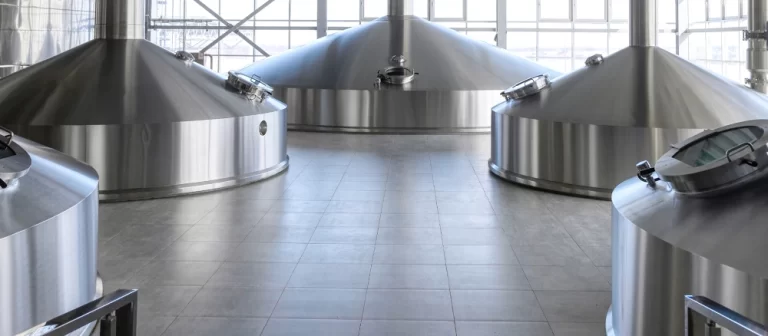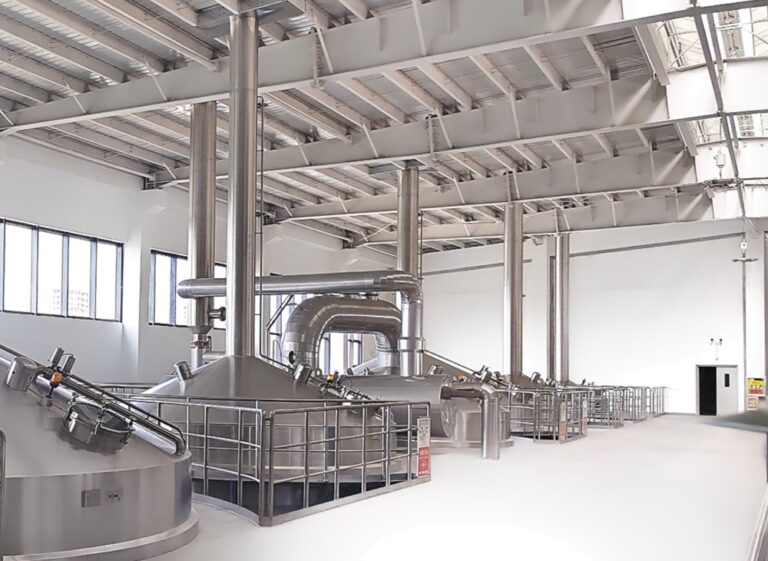
In modern large-scale breweries, fermentation tanks, water tanks, and other stainless steel process vessels are often installed outdoors or in large production halls. In addition to the tank’s main structure, the external cladding plays an important role in protecting the insulation layer, maintaining a clean appearance, and improving the overall durability of the equipment.
Traditionally, many breweries have chosen 304 stainless steel sheets as the external cladding material for insulated tanks. However, with increasing attention to project investment and equipment manufacturing costs, more brewery projects are considering an alternative: fluorocarbon-coated aluminum sheets.
This solution can significantly reduce the cost of external tank cladding while maintaining an attractive appearance and providing reliable protection for the insulation system.
So, is fluorocarbon-coated aluminum a suitable alternative to 304 stainless steel? Let’s take a closer look.
1. Why Do Brewery Tanks Need External Cladding?
For large brewery fermentation tanks, hot water tanks, cold water tanks, and other insulated vessels, the external cladding is more than just a decorative layer.
A properly designed cladding system serves several purposes:
- Protecting the insulation: It prevents rainwater, dust, and external contaminants from directly entering the insulation layer.
- Improving appearance: It gives the brewery a clean, professional, and uniform industrial appearance.
- Extending equipment service life: It helps protect the insulation and supporting structure from environmental exposure.
- Supporting outdoor installation: It provides an additional protective barrier for tanks installed outdoors.
The selection of cladding material is therefore an important consideration in large brewery equipment design.
2. What Is Fluorocarbon-Coated Aluminum Cladding?
Fluorocarbon-coated aluminum cladding is made from aluminum sheets with a fluorocarbon-based protective coating, commonly using PVDF (Polyvinylidene Fluoride) paint.
This coating provides good resistance to weathering, UV exposure, corrosion, and color fading, making it widely used in architectural and industrial applications. For brewery tanks, fluorocarbon-coated aluminum sheets can be fabricated into external cladding panels and installed over the insulation layer.
Typical advantages include:
Lightweight Construction
Aluminum sheets are considerably lighter than 304 stainless steel sheets of comparable thickness. This reduces the weight of the external cladding and can make handling and installation easier, particularly for large-diameter fermentation tanks.
Lower Material Cost
Compared with 304 stainless steel, fluorocarbon-coated aluminum can offer a more economical material solution, depending on market prices, sheet thickness, coating specifications, and fabrication requirements.
Good Weather Resistance
High-quality PVDF coatings provide excellent resistance to UV radiation, rain, and outdoor weathering. They help maintain the tank’s appearance over years of outdoor exposure.
Attractive Appearance
Fluorocarbon-coated aluminum sheets are available in different colors and surface finishes. They can provide a clean, modern, and uniform appearance across the entire brewery.
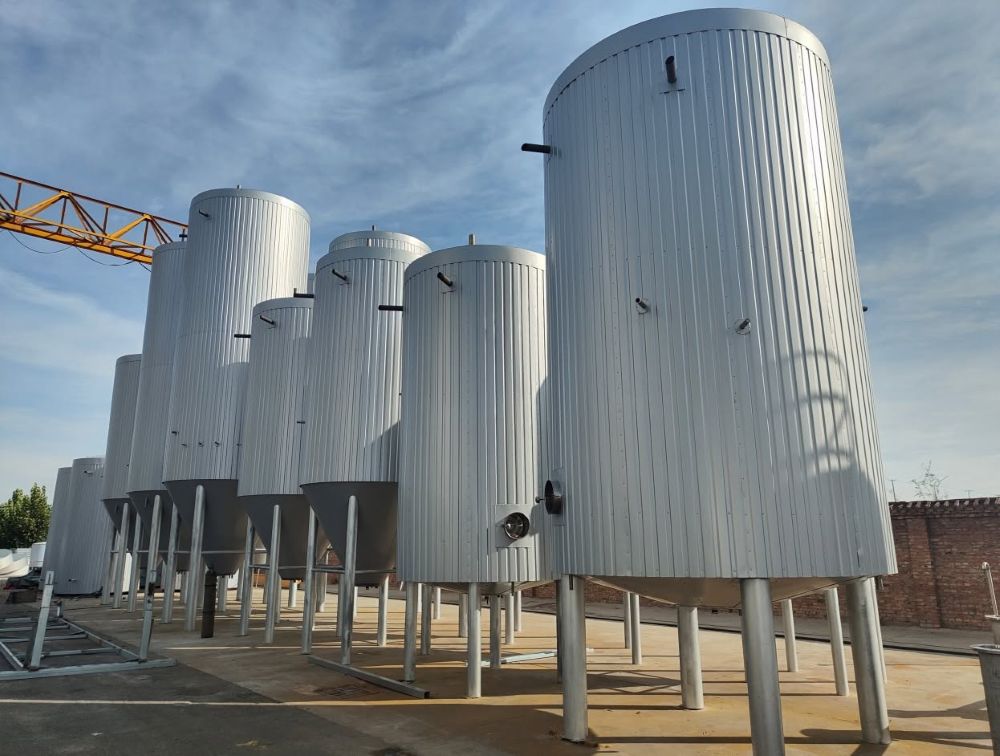
3. Why Are Some Large Breweries Choosing Aluminum Instead of 304 Stainless Steel?
For large breweries, the total surface area of external tank cladding can be substantial. Consider a brewery with multiple fermentation tanks, each having a diameter of several meters and a height of more than ten meters. When the cylindrical shell and tank heads are included, the total cladding area can reach hundreds or even thousands of square meters.
Using 304 stainless steel for all external cladding can therefore represent a considerable investment. By switching to fluorocarbon-coated aluminum sheets, breweries may achieve several economic benefits:
3.1 Reduced Initial Investment
Aluminum cladding generally costs less than 304 stainless steel cladding, making it an attractive option for breweries looking to optimize their equipment budgets.
3.2 Reduced Structural Load
Because aluminum is lighter, it reduces the additional load on the tank’s external supporting structure and insulation cladding system.
3.3 Easier Fabrication and Installation
Aluminum sheets are relatively easy to cut, bend, and shape. This can simplify the fabrication and installation process, especially for large tanks with extensive external surfaces.
3.4 Better Budget Allocation
For large brewery projects, reducing unnecessary expenditure on external decorative materials allows more investment to be allocated to critical equipment components, such as fermentation tank construction, automation systems, cooling systems, and process control.
4. Fluorocarbon-Coated Aluminum vs. 304 Stainless Steel: A Comparison
| Comparison | Fluorocarbon-Coated Aluminum | 304 Stainless Steel |
|---|---|---|
| Material cost | Generally lower | Generally higher |
| Weight | Lightweight | Relatively heavy |
| Weather resistance | Excellent with suitable PVDF coating | Excellent under normal atmospheric conditions |
| Corrosion resistance | Depends on coating integrity and aluminum alloy | Good inherent corrosion resistance |
| UV resistance | Excellent with quality PVDF coating | Excellent |
| Surface appearance | Multiple colors and finishes | Metallic stainless steel appearance |
| Fabrication | Easy to cut and bend | Requires appropriate stainless steel fabrication |
| Maintenance | Coating condition should be inspected | Generally low maintenance |
| Outdoor application | Suitable with proper design | Suitable |
Both materials can be used for brewery tank cladding. The best choice depends on the installation environment, budget, appearance requirements, and expected service life.
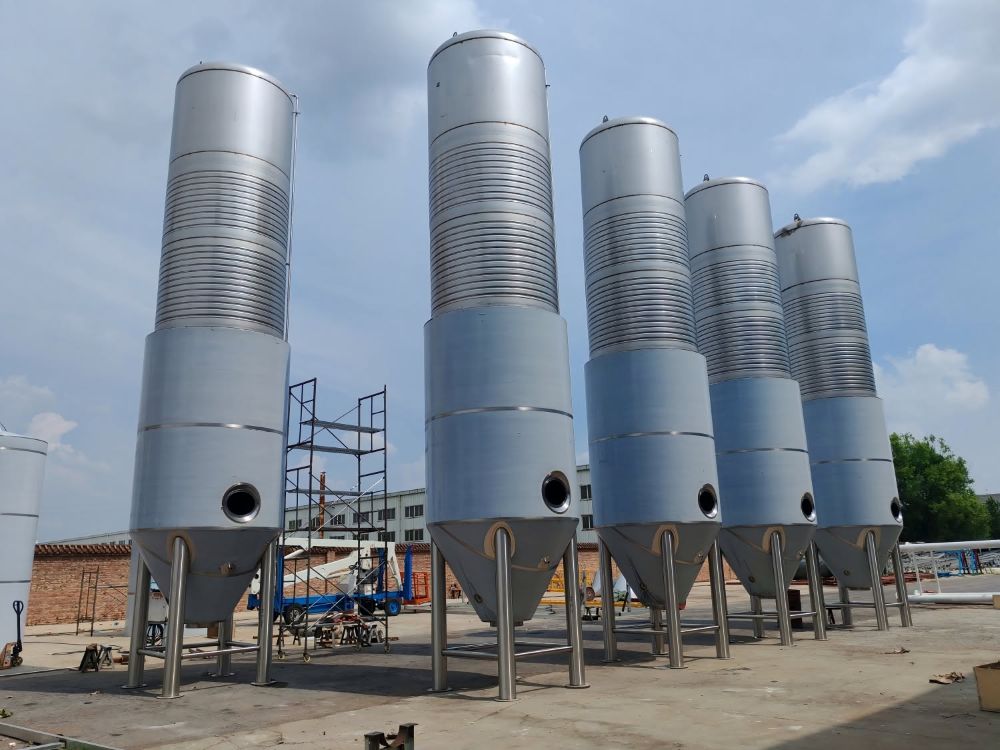
5. Important Considerations When Using Aluminum Cladding for Brewery Tanks
Although fluorocarbon-coated aluminum offers several advantages, proper engineering design is essential.
(1). Select the Right Aluminum Sheet Thickness
The sheet thickness should be selected according to tank diameter, panel dimensions, wind load, installation method, and supporting structure. The design should prevent excessive deformation, vibration, or damage during operation.
(2). Choose High-Quality PVDF Coating
For outdoor brewery installations, a high-quality PVDF fluorocarbon coating is recommended to provide long-term UV and weather resistance.
(3). Prevent Galvanic Corrosion
When aluminum comes into contact with stainless steel or other dissimilar metals in the presence of moisture, galvanic corrosion may occur.
Appropriate insulating spacers, protective washers, and compatible fasteners should be used to minimize direct metal-to-metal contact.
(4). Ensure Waterproof Installation
The joints, seams, and connections between cladding panels must be properly designed to prevent rainwater from entering the insulation layer.
(5). Consider Thermal Expansion
Aluminum has a relatively high coefficient of thermal expansion. For large tanks exposed to significant temperature changes, the cladding system should allow for thermal movement to prevent buckling or deformation.
6. Which Brewery Tanks Can Use Fluorocarbon-Coated Aluminum Cladding?
This material is particularly suitable for the external cladding of insulated brewery tanks, including:
- Beer fermentation tanks (Cylindroconical Fermenters)
- Bright beer tanks (BBT)
- Hot Liquor Tanks (HLT)
- Cold Liquor Tanks (CLT)
- Brewing water storage tanks
- Other insulated process vessels
For tanks installed outdoors, the selection of cladding should also consider local climate, wind conditions, rainfall, and maintenance requirements.
It is important to distinguish between the tank’s product-contact material and its external cladding material.
For example, the inner tank shell can still be manufactured from food-grade AISI 304 or AISI 316L stainless steel, while the insulation is protected by fluorocarbon-coated aluminum sheets.
This combination maintains the required hygienic standards for beer production while reducing the cost of non-product-contact external materials.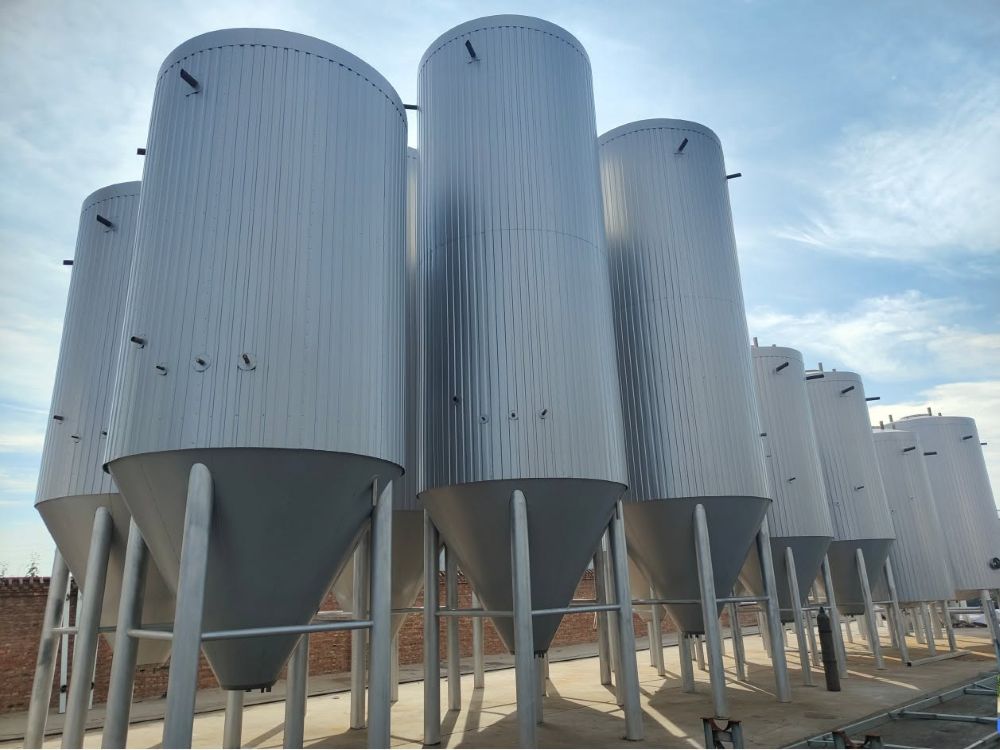
7. TIANTAI Brewtech: Practical Tank Design for Brewery Projects
At TIANTAI Brewtech, we understand that brewery equipment design is not only about selecting high-quality stainless steel materials. It is also about balancing equipment performance, manufacturing costs, installation requirements, and long-term operating reliability.
For large brewery projects, different tank components can be designed using different materials according to their actual functions.
For example:
- Inner tank shell: AISI 304 or AISI 316L stainless steel, depending on the process requirements.
- Insulation: Polyurethane or mineral wool, selected according to operating temperature and design conditions.
- External cladding: 304 stainless steel or fluorocarbon-coated aluminum sheets.
- Supporting structure and connections: Designed according to tank dimensions, loading conditions, and installation environment.
By choosing the appropriate materials for different components, TIANTAI Brewtech helps customers optimize their equipment investment without compromising essential process requirements.

Conclusion
For large breweries, using fluorocarbon-coated aluminum sheets instead of 304 stainless steel for external tank cladding can be a practical and economical solution.
It offers advantages in material cost, weight, weather resistance, and installation convenience. More importantly, it allows breweries to maintain food-grade stainless steel for all product-contact surfaces while using more economical materials for non-product-contact external structures.
The key is not to use the most expensive material everywhere, but to use the right material in the right place.
If you are planning a new brewery or expanding an existing production facility, TIANTAI Brewtech can help you evaluate different tank construction and cladding options to find the most suitable balance between quality, performance, and investment cost.
Contact TIANTAI Brewtech for professional brewery equipment solutions.
Daisy Email: [email protected]