Cold crashing is an important technique in modern craft beer production. It involves rapidly lowering the beer temperature after fermentation to encourage yeast, hop particles, and other suspended solids to settle at the bottom of the fermenter.
For breweries looking to produce clearer and more consistent beer, cold crashing can help improve the appearance of the finished product and prepare it for the next production stage.
So, how does cold crashing work, and what brewery equipment do you need?
1. What Is Cold Crashing in Beer Brewing?
Cold crashing is the process of cooling fermented beer to a low temperature, typically around 0–4°C, depending on the beer style and brewing requirements.
At lower temperatures, yeast cells tend to flocculate, forming larger groups that settle more easily at the bottom of the fermenter.
Other suspended materials, including hop particles and some protein complexes, may also settle during this process.
The main purposes of cold crashing include:
Improving beer clarity: Reducing suspended yeast and other particles helps produce a clearer beer.
Reducing sediment: More yeast and solids can settle at the bottom of the fermenter before beer transfer.
Preparing for filtration and packaging: Clearer beer can make subsequent processing easier.
Improving production consistency: Controlled cooling helps breweries achieve more predictable results.
However, not every beer needs to be completely clear. Some beer styles, such as New England IPA and Hazy IPA, are intentionally produced with a cloudy appearance.
2. How Does Cold Crashing Work?
Cold crashing works by changing the physical behavior of yeast and other suspended particles in beer.
During fermentation, yeast remains suspended in the beer. When the temperature drops, yeast activity decreases, and many yeast strains begin to aggregate and settle.
Certain proteins and polyphenols can also form complexes at low temperatures, resulting in a phenomenon known as chill haze.
Chill haze is different from permanent haze. Some chill haze disappears when beer returns to a warmer temperature, while other forms of haze may remain.
Cold crashing can encourage some of these particles to settle, but it does not remove every type of haze.
For better results, brewers should consider the beer style, yeast characteristics, dry-hopping schedule, and desired final appearance.
3. How to Perform Cold Crashing with Brewery Equipment?
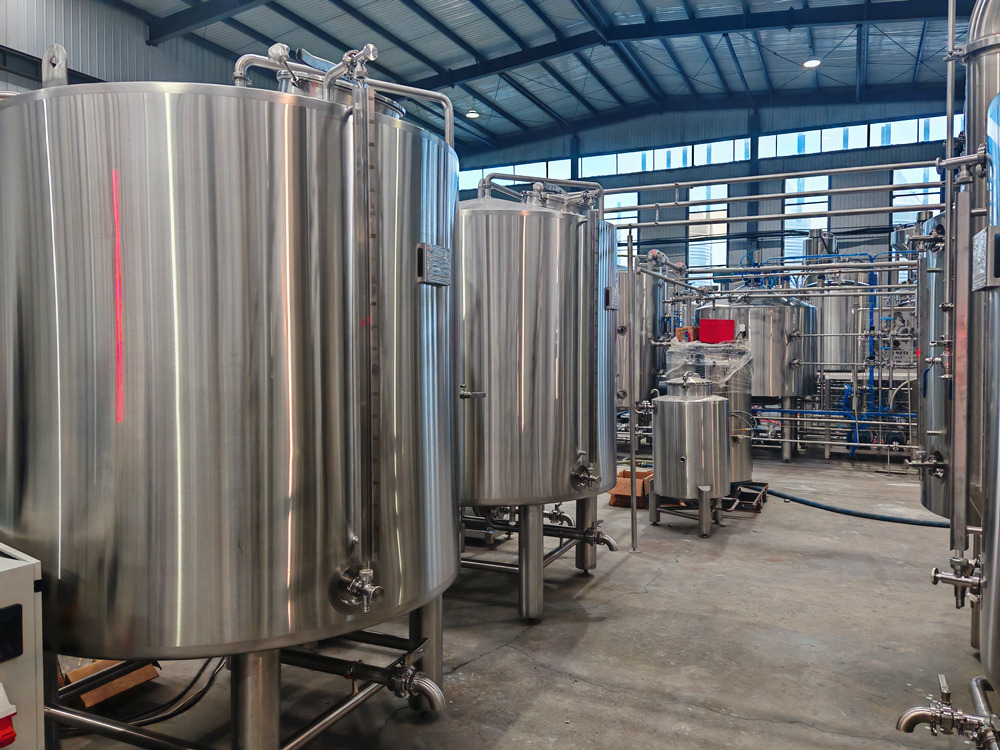
A temperature-controlled fermenter unitank equipped with a glycol cooling jacket is commonly used for cold crashing in commercial breweries.
Here is a typical operating process:
Step 1: Complete Primary Fermentation
Before starting cold crashing, confirm that fermentation has reached the required final gravity and that the beer has completed any necessary maturation steps.
For certain beer styles, a diacetyl rest or additional maturation period may be required before cooling.
Step 2: Start the Glycol Cooling System
The glycol chiller supplies chilled glycol water to the cooling jackets of the fermenter.
The temperature control cabinet monitors the beer temperature and regulates cooling according to the setpoint.
Step 3: Gradually Lower the Beer Temperature
Reduce the temperature to the target cold crashing range, commonly around 0–4°C.
The cooling speed depends on the tank capacity, cooling jacket area, glycol temperature, insulation, and refrigeration capacity.
Step 4: Maintain the Required Temperature
Keep the beer at the target temperature for an appropriate period.
Depending on the recipe and beer style, this may take several days.
During this period, yeast and suspended particles gradually settle at the bottom of the tank.
Step 5: Remove Sediment and Prepare for Packaging
Once sufficient settling has occurred, brewers can discharge the accumulated yeast and sediment through the bottom outlet of the conical fermenter.
The clarified beer can then be transferred to a brite tank or prepared for direct packaging, depending on the brewery’s production configuration.
4. Why Is a Glycol Jacketed Fermenter Important?
The fermenter is one of the most important pieces of equipment in a brewery.
For commercial beer production, a jacketed fermenter unitank offers several advantages during fermentation and cold crashing.
A typical Tiantai fermenter unitank includes:
Stainless steel inner tank for beer storage.
Glycol cooling jacket for temperature control.
PU foam insulation to reduce heat exchange.
Conical bottom for yeast and sediment collection.
Temperature sensor and control cabinet.
Pressure-rated design, depending on the selected configuration.
The glycol cooling jacket allows chilled glycol to circulate around the tank, removing heat from the beer.
PU foam insulation helps maintain the required temperature and reduces unnecessary cooling energy consumption.
With an appropriate glycol chiller and control system, brewers can manage fermentation temperatures and perform cold crashing in the same vessel.
5. Tiantai 1000L Brewery Equipment – Cooling and Fermentation System
Tiantai provides complete brewery equipment solutions for craft breweries and commercial beer production facilities.
For example, a typical 1000L brewery system can include a brewhouse, plate heat exchanger, glycol cooling system, and jacketed fermentation unitanks.
Пластинчатый теплообменник
After boiling and whirlpool separation, hot wort needs to be cooled before entering the fermenter.
In a Tiantai 1000L brewery configuration, the plate heat exchanger can be designed to cool wort from approximately 95°C to 10°C within around 30 minutes, subject to the cooling water temperature, flow rate, and actual operating conditions.
Jacketed Fermenter Unitank
The cooled wort is transferred into a double-wall stainless steel fermenter unitank.
The tank is equipped with a glycol cooling jacket and PU foam insulation.
During fermentation, the control cabinet monitors and regulates the beer temperature. After fermentation and maturation, the same cooling system can be used to lower the beer temperature for cold crashing.
This integrated configuration allows brewers to manage both fermentation and cold crashing efficiently without transferring beer between different vessels.
6. Looking for Reliable Beer Brewery Equipment?
Choosing the right brewery equipment is essential for producing consistent craft beer.
Tiantai Brewtech specializes in manufacturing complete brewing systems, including:
Brewhouse systems from 200L to 5000L and above.
Stainless steel conical fermenters.
Fermentation unitanks.
Brite beer tanks.
Glycol cooling systems.
CIP cleaning systems.
Beer filtration and packaging equipment.
We provide customized brewery solutions according to customers’ production capacity, beer styles, factory layout, and investment budget.
From initial brewery planning and equipment manufacturing to installation guidance and commissioning support, Tiantai is committed to helping customers establish efficient brewing facilities.
Planning your own brewery project?
Contact Tiantai Brewtech for professional brewery equipment solutions.
Электронная почта: [email protected]
Эмили Гонг
Tiantai Brewtech