Clean-In-Place (CIP) technology serves as the hygiene backbone of modern breweries. A standard three-tank CIP configuration, composed of a caustic tank, acid tank y depósito de agua estéril, carries out staged circulating cleaning for mashing equipment, fermentation tanks (FV), bright beer tanks (BBT), heat exchangers, pipelines and filling lines. No equipment disassembly is required during operation. Each tank performs a distinct cleaning function, and their coordinated work removes stubborn residues and minimizes microbial hazards to guarantee stable beer production. Actual working temperatures and chemical concentrations should be adjusted according to cleaned objects, detergent suppliers and equipment material properties.
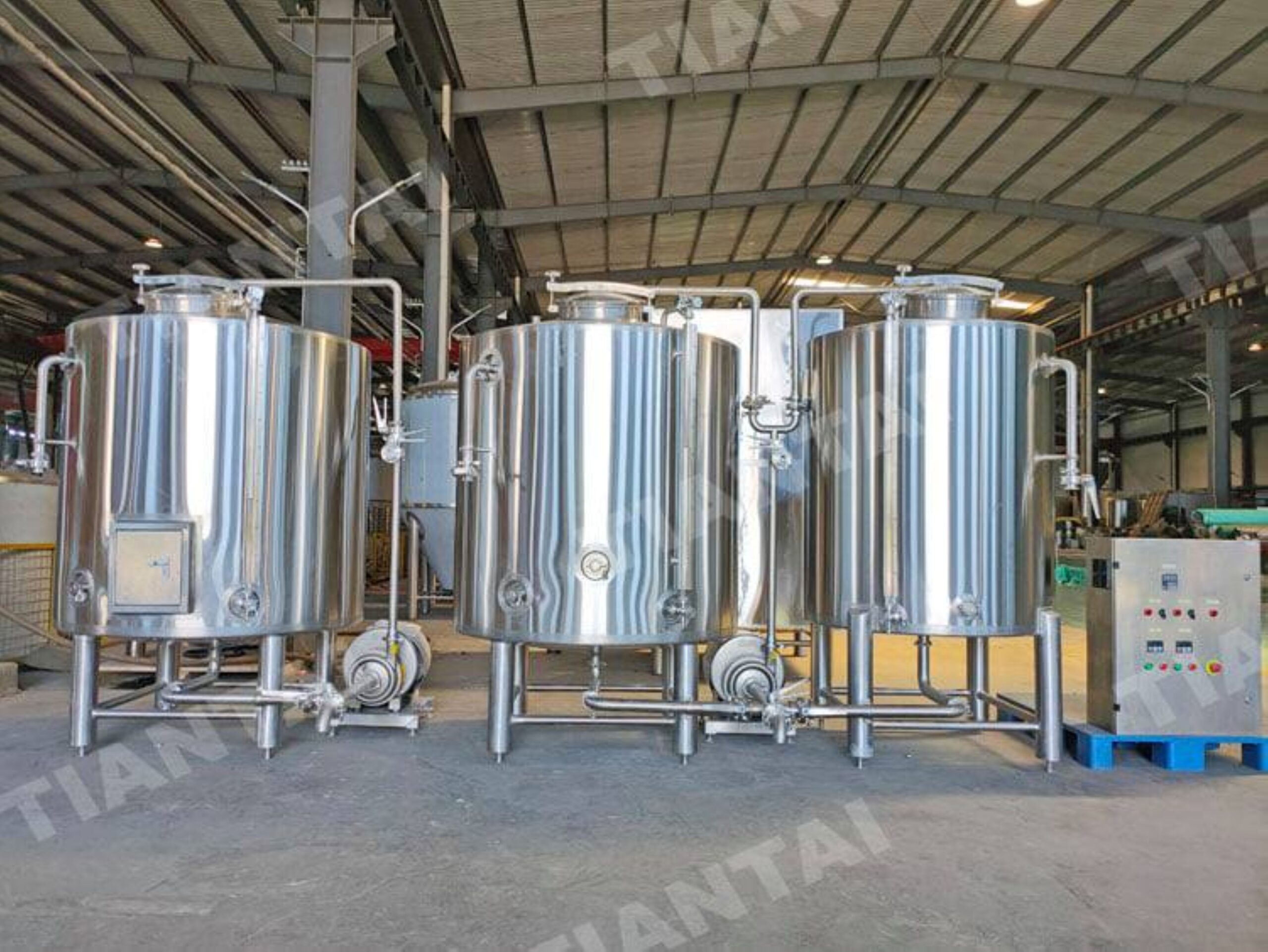
En caustic tank stores and circulates sodium hydroxide solution at 70–85°C, executing the most critical organic cleaning stage. Yeast, protein, wort and beer residues, grease and organic substances tend to stick firmly to tank interiors and pipework, which simple water flushing cannot completely remove. In a closed circulation loop, alkaline liquid flows from the caustic tank through CIP pumps, reaches spray balls inside fermentation vessels to wash tank walls, and simultaneously cleans bottom valves and connecting pipelines. The fluid then flows back to the caustic tank for repeated circulation. Once the cleaning cycle finishes, the caustic solution can be recovered and reused after conductivity and concentration inspection.
Operating at 50–70°C, the acid tank is designed to tackle inorganic deposits resistant to alkaline washing, including beer stone, calcium salts, magnesium salts and mineral scales. Widely used acid cleaners include nitric acid, phosphoric acid and compound CIP acids. Acid cleaning is implemented after caustic washing and intermediate water rinse. It does not need to run after every production batch. Most breweries schedule acid cycles every 3 to 10 batches, determined by local water quality, beer varieties and equipment operation status.
En depósito de agua estéril provides hot rinse water at 80–90°C for the final rinse step. It washes away leftover chemical agents and lowers the risk of secondary microbial contamination. Sterile water quality is maintained by thermal sterilization, constant temperature holding, filtration or sterile air protection. After the final rinse of fermentation tanks, the vessel stays hygienic and ready for the next brewing cycle.
A full CIP procedure for a 100HL fermentation tank follows this sequence: product drain, pre-rinse, caustic cleaning, intermediate water rinse, periodic acid cleaning, water rinse, sterile hot water rinse and final drain. A complete CIP system contains more hardware beyond the three tanks: CIP pumps, plate heat exchangers, return pumps, chemical dosing systems, conductivity sensors, temperature sensors, spray balls and a PLC control cabinet. Operators can choose target vessels and predefined cleaning recipes for fully automatic operation. The PLC system controls valve switching, pump running, temperature, cleaning duration, chemical concentration, liquid return, drainage and fault alarms.
This three-tank CIP setup delivers repeatable and verifiable sanitation results. It preserves beer flavour stability, cuts contamination risks and reduces manual cleaning workload, making it indispensable for both craft breweries and large-scale industrial beer manufacturers.
If you are interested in any CIP equipment or brewery equipment, please feel free to contact us:
Ivy Liang(Directora de Ventas)
Correo electrónico: [email protected]