When planning a new distillery or upgrading an existing production facility, choosing the right heating method is one of the most important decisions. Heating directly affects distillation efficiency, product quality, energy consumption, operating costs, and overall production capacity.
For modern distillery equipment, the two most common heating options are steam heating and electric heating. Both have their advantages, but which one is better for your distillery? The answer depends on your production scale, available energy sources, investment budget, and operational requirements.
Let’s compare these two heating methods to help you make the right decision.
1. Steam Heating for Distillery Equipment
Steam heating is widely used in medium-sized and large-scale commercial distilleries. In this system, a steam boiler generates steam, which is delivered through pipes to the heating jackets or internal heat exchangers of the distillation equipment.
The steam transfers heat to the liquid inside the distillation kettle, providing stable and relatively uniform heating.
Advantages of Steam Heating:
Uniform heat distribution: Steam provides consistent heating across the vessel surface, helping reduce localized overheating.
Suitable for large production capacities: It is an ideal solution for industrial distillation systems and continuous production.
Flexible temperature control: Steam pressure can be adjusted to control the heating temperature.
Multiple equipment connections: One central steam boiler can supply several distillation kettles and other process equipment.
Flexible energy options: Depending on local conditions, boilers can use natural gas, LPG, diesel, biomass, or other suitable fuels.
Consideraciones:
Steam heating requires additional investment in a steam boiler, piping, valves, condensate return systems, and relevant safety devices. The boiler also requires regular inspection and maintenance.
For distilleries with multiple production vessels or high daily output, these additional costs can be justified by the flexibility and heating capacity of a centralized steam system.
2. Electric Heating for Distillery Equipment
Electric heating is commonly used in small and medium-sized distilleries, pilot plants, and craft distillation facilities.
In this system, electric heating elements are installed inside the heating zone or integrated into the equipment design. Electrical energy is converted directly into heat, which is transferred to the product.
Advantages of Electric Heating:
Simple installation: No separate steam boiler or extensive steam piping system is required.
Easy operation: The heating power can be adjusted through an electrical control system.
Compact design: Electric heating is suitable for facilities with limited installation space.
Clean operation: There is no combustion process at the point of use, and no local flue gas emissions from the heating elements.
Convenient automation: Electric heating can be integrated with PLC control systems for temperature monitoring and automatic heating adjustment.
Consideraciones:
Electric heating may require a high electrical power supply, especially for larger distillation systems. The availability of three-phase electricity, transformer capacity, and local electricity prices should all be considered before selecting this option.
For large industrial distilleries, the electrical infrastructure and operating costs may become significant.
3. Steam Heating vs. Electric Heating: Key Differences
La siguiente tabla resume las principales diferencias:
| Comparison | Steam Heating | Electric Heating |
| Inversión inicial | Más alto | Usually lower for small systems |
| Instalación | Más complejo | Relatively simple |
| Heating control | By steam pressure and control valves | By electrical power control |
| Production scale | Medium to large | Small to medium |
| Space requirements | Boiler room and piping needed | More compact |
| Mantenimiento | Boiler and steam system maintenance | Heating elements and electrical system maintenance |
| Costes energéticos | Depends on boiler fuel and efficiency | Depends on electricity prices |
| Multi-vessel heating | Excelente | Requires separate or distributed electrical capacity |
There is no universal winner. The most economical solution depends on local energy prices, equipment size, production schedules, and the complete installation cost.
4. Which Heating Method Should You Choose?
For a small craft distillery producing whisky, gin, vodka, or other spirits, electric heating can be a practical choice. It offers convenient operation, compact installation, and straightforward temperature control.
For medium-sized and large commercial distilleries, steam heating is often more suitable. A centralized boiler can supply several distillation vessels and other equipment, making it easier to expand production capacity.
Before making a decision, consider the following questions:
What is your required production capacity?
How many distillation kettles will operate simultaneously?
What energy sources are available at your facility?
What are the local electricity and fuel prices?
Do you have sufficient electrical capacity or space for a boiler room?
Do you plan to expand production in the future?
A professional equipment supplier can evaluate these factors and recommend the most suitable heating configuration.
5. Customized Distillery Equipment Solutions from Tiantai
At Tiantai, we understand that every distillery project has different production requirements, energy conditions, and investment budgets.
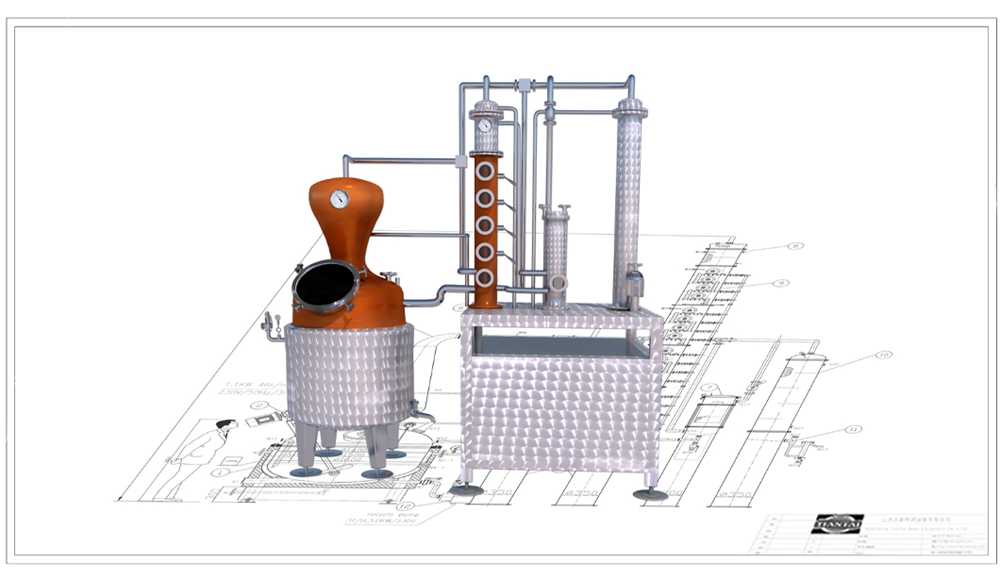
We provide customized distillery equipment with both steam and electric heating options, covering distillation kettles, columns, condensers, storage tanks, and complete alcohol production systems.
Whether you are establishing a small craft distillery or building a large commercial alcohol production facility, our engineering team can help design a suitable solution based on your production capacity, raw materials, target alcohol strength, and available energy sources.
We also provide equipment layout design, technical drawings, piping solutions, installation guidance, and after-sales support.
Steam or electric heating? The best choice is the one that delivers the right balance of production efficiency, energy consumption, and long-term operating costs for your distillery.
Contact Tiantai today to discuss your distillery project and receive a customized equipment proposal.
Contact:Ivy Liang
Correo electrónico: [email protected]