Making excellent craft beer involves more than selecting quality ingredients and following a good brewing recipe. Beer conditioning is another essential stage that influences the final flavor, aroma, clarity, and carbonation of your beer.
For small breweries and microbrewery factories, choosing suitable fermentation and conditioning equipment can make a significant difference in production efficiency and beer quality.
So, how does beer conditioning work? And which brewery tanks are suitable for this process?
1. What Happens During Beer Conditioning?
Beer conditioning is the process in which freshly fermented beer develops its final characteristics before packaging or consumption.
After primary fermentation, yeast continues to play an important role. Depending on the beer style and fermentation conditions, additional maturation time allows yeast to reduce certain unwanted flavor compounds and helps the beer develop a more balanced taste.
For example:
– Yeast can reduce diacetyl, which may otherwise create a buttery flavor.
– Some fermentation-related off-flavors gradually decrease during maturation.
– Yeast and other suspended particles settle, improving beer clarity.
– Carbonation can develop through natural secondary fermentation or be adjusted through forced carbonation.
The required conditioning time depends on the beer recipe, yeast strain, alcohol content, and production method. There is no single conditioning period suitable for every beer style.
2. Which Brewery Tanks Are Used for Beer Conditioning?
Different brewery tanks serve different purposes throughout the brewing process. Three common equipment options are conical fermenters, fermentation unitanks, and brite tanks.
Conical Fermenter
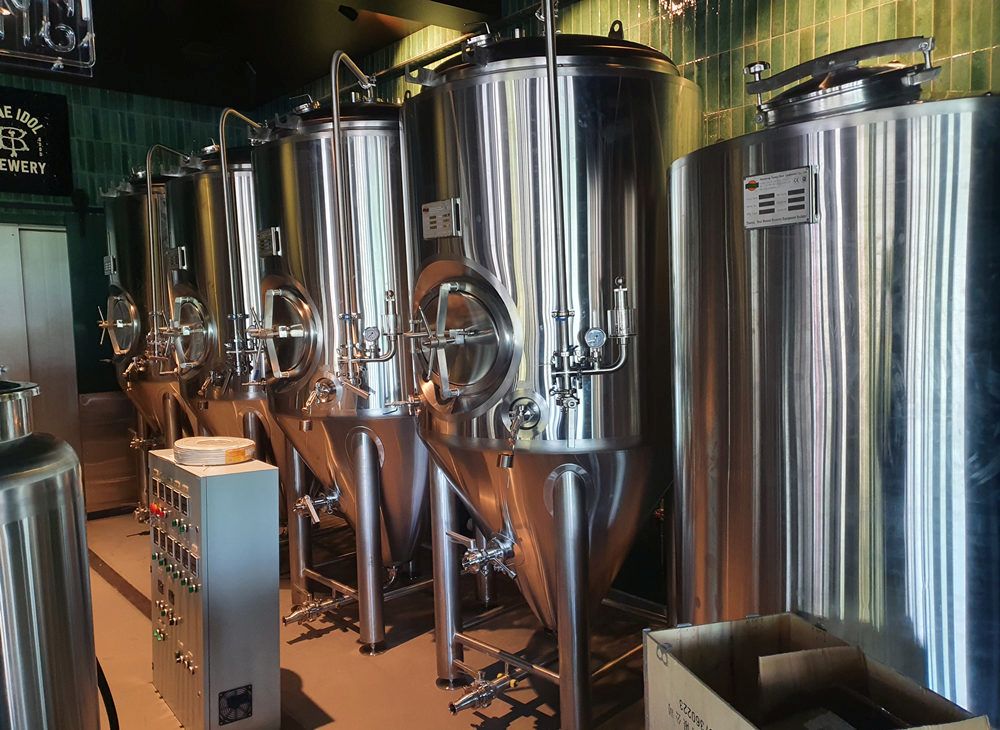
A conical fermenter is widely used in craft breweries for primary fermentation and yeast collection.
Its cone-shaped bottom allows yeast and sediment to settle naturally. Brewers can discharge accumulated yeast through the bottom outlet without transferring the entire beer batch.
Depending on its design, a conical fermenter may also be equipped with a cooling jacket, insulation, pressure-rated construction, and temperature control.
Fermentation Unitank
A unitank combines fermentation and beer conditioning functions in one vessel.
It is particularly suitable for breweries that want to simplify their production process and reduce beer transfers between tanks.
Typical functions include:
– Primary beer fermentation.
– Temperature-controlled maturation.
– Yeast sediment collection and discharge.
– Cold crashing.
– Natural or forced carbonation, if the tank is designed for pressure operation.
Using a unitank can reduce additional transfer operations and help minimize beer exposure to oxygen.
Brite Tank (Bright Beer Tank)
A brite tank is generally used after fermentation and maturation.
It provides a controlled environment for final beer clarification, carbonation adjustment, and temporary storage before packaging.
Brewers commonly use brite tanks for:
– Final beer conditioning.
– Forced carbonation using a carbonation stone.
– Beer clarification and sediment settling.
– Maintaining beer under pressure before bottling, canning, or keg filling.
For breweries producing multiple beer styles, dedicated brite tanks also provide greater flexibility in production scheduling.
3. Why Is Cold Conditioning Important?
Cold conditioning, often called cold crashing in the brewing process, involves lowering the beer temperature to encourage suspended yeast and other particles to settle.
This process offers several benefits:
Improved beer clarity
Lower temperatures encourage yeast and suspended particles to settle at the bottom of the tank, helping produce clearer beer.
Better carbonation
Cold beer can retain more dissolved CO₂ than warm beer at the same pressure. This makes temperature control important when adjusting carbonation levels.
More stable beer before packaging
Removing excessive suspended yeast and sediment can help improve the appearance and consistency of the finished product.
The appropriate cold conditioning temperature and duration depend on the beer style, tank design, and production requirements.
4. Bottle Conditioning vs. Tank Conditioning
There are two common approaches to developing and carbonating craft beer.
Bottle Conditioning
In bottle conditioning, a measured quantity of fermentable sugar is added before packaging. The remaining yeast ferments this sugar inside the sealed bottle, naturally producing CO₂.
This method is often used for traditional craft beers and specialty beer styles.
During this stage, bottles are generally stored at a suitable fermentation temperature to allow secondary fermentation to finish.
After carbonation is complete, refrigeration helps chill the beer, improve sediment settling, and maintain carbonation during serving.
As a general serving preparation guideline, chilling bottles for 48–72 hours or longer can be helpful, although the ideal time varies.
Tank Conditioning
Tank conditioning takes place in pressure-rated fermentation tanks or dedicated brite tanks.
Brewers can use controlled fermentation or forced carbonation to achieve the desired carbonation level before packaging.
This method is widely used in commercial breweries because it allows better control over carbonation, beer transfer, and packaging operations.
5. Additional Tips for Better Beer Conditioning
Tiantai Brewtech shares several practical considerations for craft breweries:
1. Pay attention to beer style.Hoppy beers such as IPA and Pale Ale are best consumed relatively fresh because their hop aroma and flavor can gradually fade during storage.
2. Allow stronger beers sufficient maturation time.Some high-alcohol beers benefit from longer conditioning, which can help their flavors become more integrated and balanced.
3. Control oxygen exposure.Oxygen can negatively affect beer flavor, especially during maturation and packaging. Closed transfers and suitable oxygen-barrier packaging are important.
4. Maintain proper temperature control.Consistent temperature management helps yeast perform as expected and supports a more predictable conditioning process.
5. Choose suitable tanks for your production capacity.The number and capacity of fermenters and brite tanks should match your brewing schedule and packaging requirements.
If you are planning to establish a new craft brewery or expand an existing beer production facility, selecting the right equipment is an important first step.
A typical craft beer production system may include:
– Malt milling system.
– Brewhouse with mash tun, lauter tun, brew kettle, and whirlpool.
– Hot liquor tank.
– Glycol cooling system.
– Conical fermentation tanks or fermentation unitanks.
– Brite beer tanks.
– CIP cleaning system.
– Beer filtration equipment, if required.
– Kegging, bottling, or canning equipment.
The final configuration depends on your target production capacity, beer styles, available space, utilities, and packaging method.
Tiantai Brewtech – Your Brewery Equipment Manufacturing Partner
Tiantai specializes in the design and manufacture of complete brewing systems for breweries of different sizes.
Our product range includes:
– 200L, 300L, 500L, 600L, 800L, 1000L, 1500L, 2000L, 2500L, 3000L, and 5000L brewing systems.
– Stainless steel conical fermenters and fermentation unitanks.
– Brite tanks and beer storage tanks.
– CIP cleaning systems and glycol cooling systems.
– Cider production equipment.
– Kombucha fermentation equipment.
– Hard seltzer production equipment.
– Brewery accessories and packaging equipment.
Beyond equipment manufacturing, we can also support customers with brewery project planning, equipment configuration, brewing training, installation guidance, and commissioning.
Whether you are planning a small microbrewery, a brewpub, or a commercial beer production facility, our team can help develop an equipment solution according to your project requirements.
Contact Tiantai Brewtech to discuss your brewing capacity, equipment requirements, and project budget.
Email: [email protected]
Emily Gong
Tiantai Brewtech