In modern whisky distillery projects, efficiency, extract yield, and process consistency are more important than ever. While traditional lauter tuns are still widely used, many progressive distilleries are now turning to mash filters to improve performance during the mashing stage. For new-build distilleries or brewery–distillery hybrid projects, the mash filter offers clear technical and economic advantages.
This article explores the role of the mash filter in whisky production and introduces a standard 2000L mash filter system configuration suitable for craft and medium-scale distillery projects.
1.Understanding the Mashing Stage in Whisky Production
Before fermentation and distillation, starch from grains must be converted into fermentable sugars. In single malt whisky production—especially styles inspired by regions such as Speyside or Highlands—this process begins with malted barley. In grain whisky production, additional cereals such as corn or wheat may be included.
The main objectives of mashing are:
Activate enzymes (mainly alpha and beta amylase)
Convert starch into fermentable sugars
Extract maximum soluble solids
Separate wort from spent grain efficiently
Traditionally, a lauter tun separates the liquid wort from the grain bed by gravity filtration. However, this method depends heavily on grain bed permeability and grist quality. When using high proportions of unmalted grains or fine grinds, separation efficiency can decrease significantly.
This is where a mash filter becomes a superior alternative.
2.What Is a Mash Filter?
A mash filter is a pressure filtration system designed to separate wort from mash solids using filter plates and membranes. Unlike a lauter tun, which relies on a natural grain bed, the mash filter uses mechanical pressure to extract liquid.
The system consists of:
Multiple filter plates with filter cloths
Inflatable membrane plates
Hydraulic closing system
Wort collection channels
Automated control valves
The mash is pumped into chambers between filter plates. Once filled, membranes inflate and apply pressure, squeezing liquid through the filter cloth. The result is a clear wort and a compact, low-moisture spent grain cake.
3.Advantages of Mash Filter in Whisky Projects
3.1 Higher Extract Efficiency
Mash filters can achieve extract efficiencies up to 98–99% of available sugars. This significantly improves alcohol yield per ton of grain compared to traditional lauter systems.
For commercial whisky projects, even a 1–2% increase in extraction can represent substantial long-term revenue growth.
3.2Flexible Grain Bills
Mash filters handle:
100% malted barley
High corn ratios
Wheat-based recipes
Rye-heavy formulations
This makes them especially suitable for distilleries producing multiple whisky styles, including Scotch-style malt whisky, American-style bourbon mash bills, or experimental craft spirits.
3.3 Faster Filtration Cycles
Because filtration occurs under pressure, separation is much faster than gravity lautering. Typical mash filter cycles range from 1.5 to 2 hours, depending on recipe and volume.
3.4 Clearer Wort
The pressure filtration process produces very low turbidity wort. While some distillers prefer slight solids carryover for flavor development, mash filter clarity offers improved process control and repeatability.
3.5 Lower Spent Grain Moisture
Spent grains discharged from a mash filter typically contain 55–60% moisture, compared to 75–80% from lauter tuns. This reduces waste weight and improves by-product handling or resale value as animal feed.
4.Mash Filter vs. Lauter Tun: A Quick Comparison
| Extraction Efficiency | Very High (98–99%) | Moderate (90–95%) |
| Grain Flexibility | 素晴らしい | 限定 |
| Filtration Speed | Fast | 中程度 |
| オートメーション・レベル | 高い | ミディアム |
| Capital Investment | より高い | より低い |
For high-efficiency commercial whisky projects, the mash filter is increasingly becoming the preferred solution.
5.Tiantai 2000L Mash Filter System Introduction
A 2000L mash filter system is an ideal solution for craft distilleries or brewery–distillery combination projects targeting:
2000L mash capacity per batch
1–3 batches per day
Annual whisky production capacity of approximately 300,000–600,000 liters (depending on fermentation and distillation setup)
5.1 Basic Technical Specifications
Effective mash volume: 2000 liters per batch
Filter plate size: Typically 800mm × 800mm
Number of plates: 20–30 plates (depending on filtration area requirement)
Filtration area: Approximately 20–30 m²
Operating pressure: 6–8 bar
Cycle time: 1.5–2 hours
5.2 Main System Components
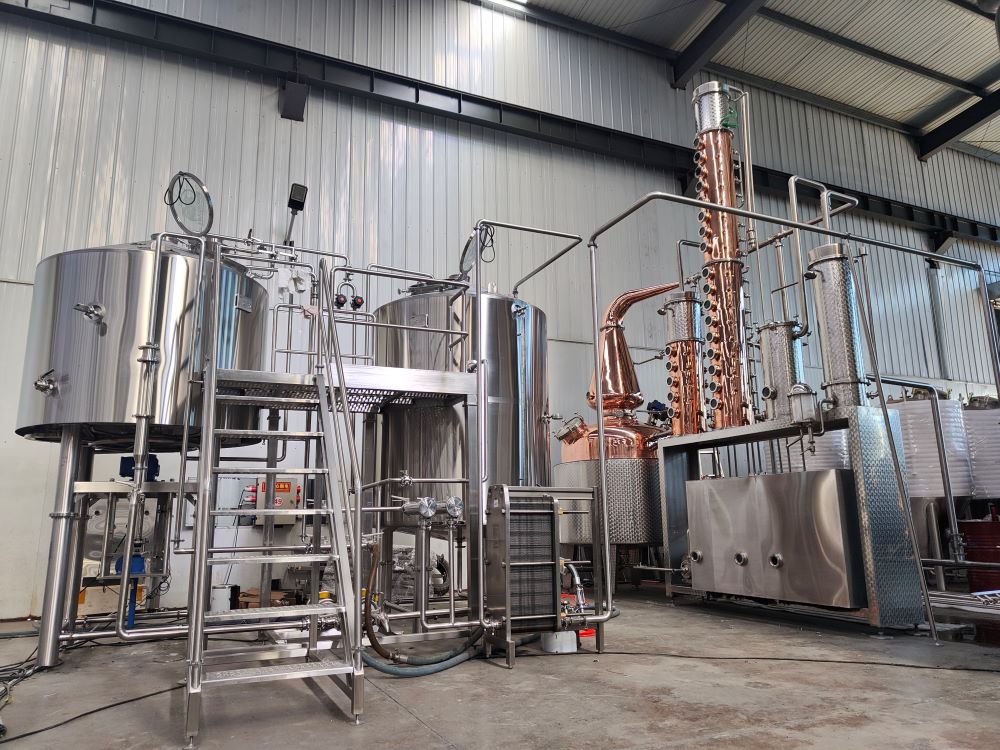
A standard 2000L mash filter system includes:
(1) Mash Cooker / Conversion Tank
Steam jacket or internal calandria heating
Agitator with variable frequency control
Temperature automation
Insulated stainless steel construction (SUS304 or SUS316)
This tank handles starch gelatinization (for corn or unmalted grains) and enzymatic conversion.
(2) Mash Transfer Pump
Food-grade centrifugal pump
Variable flow rate
CIP-compatible design
(3) Mash Filter Unit
Stainless steel frame
Polypropylene or stainless filter plates
Food-grade filter cloths
Pneumatic membrane squeezing system
Automatic hydraulic closing system
(4) Wort Collection Tank
Insulated
Level control system
Temperature sensor
(5) Control System
Semi-automatic or fully automatic PLC control
Pressure monitoring
Valve sequencing automation
Touchscreen HMI interface

6.Operational Process of a 2000L Mash Filter System
6.1 Mashing & Conversion
Grain and water are mixed in the mash cooker.
Temperature steps are controlled precisely (e.g., 62°C, 72°C, 78°C).
6.2Transfer to Mash Filter
Fully converted mash is pumped into filter chambers.
6.3Chamber Filling
Chambers are filled evenly to ensure uniform filtration.
6.4Membrane Pressing
Membranes inflate to apply pressure.
Wort is extracted efficiently.
6.5Air Blow / Final Squeeze
Compressed air may be used to recover residual wort.
6.6Cake Discharge
Plates open automatically.
Spent grain cake drops into a collection system.
The entire process is automated for consistency and labor reduction.
7.Utility Requirements for 2000L System
Steam supply (0.4–0.8 MPa recommended)
Compressed air (6–8 bar)
温水タンク
CIP洗浄システム
Electrical control cabinet
Proper integration with fermentation tanks and distillation stills ensures smooth workflow.
8.Application Scenarios
A 2000L mash filter system is suitable for:
Craft whisky distilleries
Multi-spirit distilleries
Brewery expansions into whisky production
Pilot-scale commercial distillery projects
High-efficiency bourbon-style mash bills
For distilleries producing American-style bourbon in compliance with regulations set by the Alcohol and Tobacco Tax and Trade Bureau, mash filters offer precise grain bill control and high extract efficiency—critical for maintaining profitability at scale.
9.Investment and ROI Consideration
Although mash filters require higher initial investment compared to lauter tuns, the return on investment comes from:
Higher alcohol yield
Reduced raw material waste
Faster batch turnover
Lower labor cost
Reduced wastewater load
For medium-capacity distilleries, payback periods are often achieved within 2–3 years depending on production scale.
The mash filter represents a modern, high-efficiency solution for whisky production. It provides superior extraction rates, operational flexibility, and process consistency—making it ideal for contemporary distillery projects.
Tiantai 2000L mash filter system offers the perfect balance between craft-scale control and commercial-scale efficiency. Whether you are building a new whisky distillery or expanding from brewing into spirits production, integrating a mash filter into your mashing stage can significantly improve both product quality and economic performance.
If you are planning a whisky project and would like technical layout design, equipment configuration, or turnkey distillery solutions, a properly engineered mash filter system can become the foundation of your production success.
編集者:デイジー
[email protected]