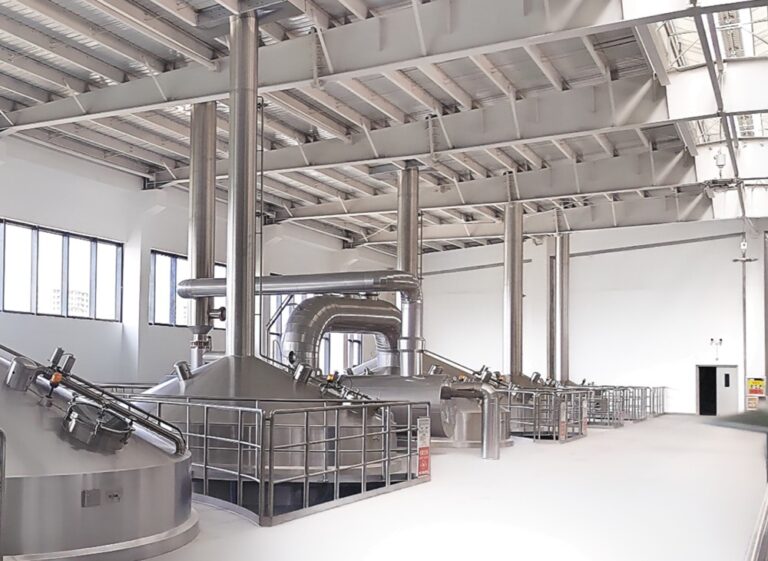
In modern industrial brewery equipment, maintaining beer clarity is a key indicator of product quality and process efficiency. As breweries increasingly adopt automated brewing equipment, turbidity sensors have become essential tools for monitoring and controlling beer clarity throughout the production process.
Turbidity refers to the concentration of suspended particles in a liquid, making it a critical parameter in any beer production line. By accurately measuring turbidity levels during stages such as wort clarification, filtration, and final beer processing, breweries can ensure consistent appearance, stability, and taste.
For commercial brewery equipment and large-scale brewing operations, integrating turbidity sensors enables real-time quality control, reduces product loss, and enhances overall production efficiency. In this article, we will explore how turbidity sensors are applied in brewery systems and why they are indispensable in modern beer production.
Turbidity is a measure of the cloudiness or haziness of a liquid caused by suspended particles that scatter light. Turbidity is typically measured in nephelometric turbidity units (NTU), and it is often used as an indicator of water quality or beer clarity.
Why is Turbidity Important in Beer Brewing?
Turbidity is important in beer brewing because it affects the appearance, flavor, and stability of the final product. The clarity of beer is a key factor in its visual appeal, and consumers often associate a clear beer with quality. Additionally, high levels of turbidity can affect the flavor and aroma of beer by providing a substrate for bacterial growth and altering the balance of proteins and hop compounds in the beer. Finally, high levels of turbidity can reduce the shelf life of beer by providing a substrate for yeast and bacterial growth.
Turbidity sensors work by shining a light through a sample of liquid and measuring the amount of light scattered by suspended particles. The amount of light scattered is proportional to the amount of particles in the liquid, and the sensor converts this information into a turbidity value. Turbidity sensors can be either analog or digital. Analog turbidity sensors output a voltage that is proportional to the turbidity value, while digital turbidity sensors output a digital signal that can be read by a microcontroller or computer.
Turbidity sensors are used in various stages of the beer brewing process, including during mashing, boiling, fermentation, and filtration. In mashing, turbidity sensors are used to measure the clarity of the wort, which is the liquid extracted from the malted grains. In boiling, turbidity sensors are used to measure the level of protein coagulation and determine when the boil should be stopped. In fermentation, turbidity sensors are used to monitor the level of yeast and bacterial growth and to ensure that the beer is fermenting properly. In filtration, turbidity sensors are used to measure the clarity of the beer and to ensure that it meets the desired level of turbidity.
In conclusion, turbidity sensors are an important tool for maintaining the quality of beer produced in industrial beer brewery equipment. By measuring the level of suspended particles in the beer, turbidity sensors ensure that the beer has the desired appearance, flavor, and stability. Turbidity sensors can be integrated into brewing equipment in various ways, and they can be connected to a microcontroller or computer to automate the monitoring process and provide real-time feedback.
[email protected]
에밀리 공