In modern breweries, fermentation tanks are almost always designed with glycol coolant entering from the bottom and exiting from the top. This simple yet highly effective engineering choice enhances cooling efficiency, temperature stability, and overall beer quality.
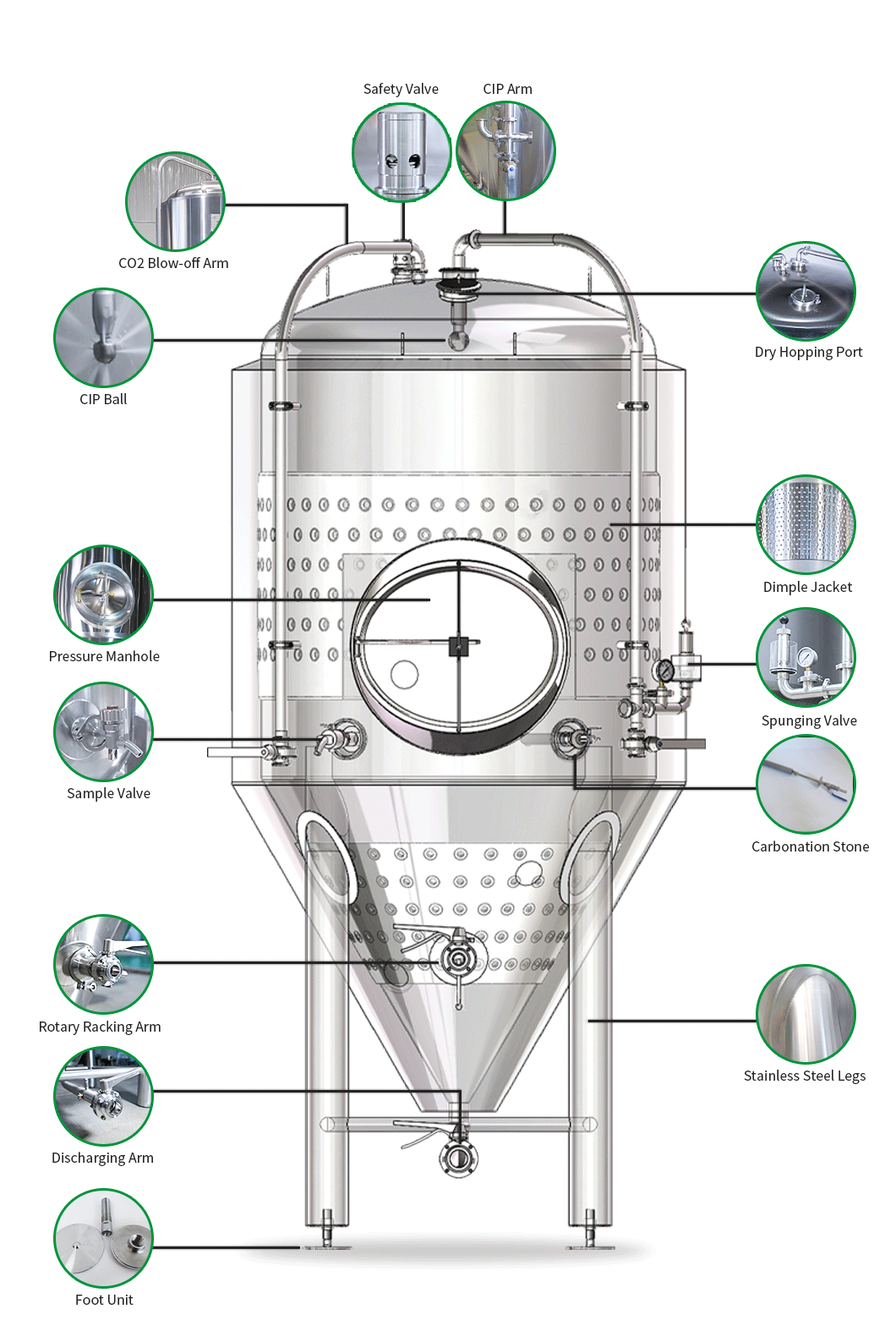
The primary reason lies in thermal dynamics. Cold glycol introduced at the bottom naturally absorbs heat and rises as it warms. By allowing the coolant to travel upward through the cooling jackets, the system follows the natural direction of heat transfer, ensuring smoother, more uniform temperature control throughout the entire tank.
This design also helps maintain a consistent fermentation environment. Yeast activity generates heat, particularly in the center and upper sections of the tank. With the coolant moving upward, the system counteracts these heat zones more effectively, preventing hotspots and keeping the fermentation curve stable.
Another key benefit is improved energy efficiency. Because the coolant warms gradually as it rises, the tank achieves better heat exchange performance, reducing glycol system workload and saving operational costs over time.
Finally, the bottom-in, top-out configuration minimizes air pockets inside the jacket, ensuring complete coolant coverage and preventing uneven cooling.
In short, this design reflects smart engineering that supports cleaner fermentation, more consistent beer quality, and more efficient brewery operations.
읽어주셔서 대단히 감사합니다.
헬렌