In a professional brewery, fermentation tanks are equipped with several important accessories to ensure safe, stable, and hygienic operation. Among them, the mechanical blow-off valve and the safety valve are two components that are sometimes confused because both are related to pressure control.
However, these two devices have different functions, working principles, and structural designs. Understanding their differences is essential when selecting the right accessories for beer fermentation tanks.
In this article, TIANTAI Brewtech explains how mechanical blow-off valves and safety valves work, why both are important, and how they contribute to brewery safety and fermentation management.
1. What Is a Mechanical Blow-Off Valve?
A mechanical blow-off valve is a pressure-control device commonly installed on beer fermentation tanks. Its primary function is to release excess fermentation gas and maintain a relatively stable positive pressure inside the tank.
During beer fermentation, yeast converts fermentable sugars into alcohol and carbon dioxide (CO₂). As fermentation progresses, a large amount of CO₂ is generated, increasing the pressure inside the fermenter.
The mechanical blow-off valve allows excess CO₂ to escape when the internal pressure reaches the preset operating pressure.
Working Principle
A typical mechanical blow-off valve consists of a pressure-adjustment mechanism, a spring or mechanical loading structure, a valve body, and a gas discharge outlet.
When the pressure inside the fermentation tank exceeds the valve’s preset opening pressure, the internal pressure overcomes the mechanical closing force, causing the valve to open and release CO₂.
When the pressure decreases below the closing threshold, the valve automatically returns to its closed position.
Depending on the design, the valve may also incorporate a pressure-adjustment mechanism to allow operators to set the desired fermentation pressure.
Main Functions
- Releases excess CO₂ generated during fermentation.
- Helps maintain the desired positive pressure inside the fermenter.
- Allows controlled pressure fermentation.
- Helps prevent excessive pressure buildup during normal fermentation.
- Supports consistent fermentation conditions.
A mechanical blow-off valve is particularly useful for breweries using pressure fermentation, where maintaining a controlled internal pressure is important for beer quality and production efficiency.
2. What Is a Safety Valve?
A safety valve is a protective device designed to prevent a fermentation tank from experiencing excessive pressure that could damage the tank or create a safety hazard.
Unlike a mechanical blow-off valve, which is generally used for routine fermentation pressure regulation, the safety valve is primarily an emergency overpressure protection device.
If the pressure inside the tank rises above the maximum allowable pressure, the safety valve automatically opens to discharge excess gas.
Once the pressure drops to a safe level, the valve closes again, depending on its design.

Working Principle
A typical mechanical safety valve consists of a valve body, spring, valve disc, sealing seat, and pressure-adjustment mechanism.
Under normal operating conditions, the spring force keeps the valve disc pressed against the sealing seat.
When the internal pressure reaches the predetermined safety setting, the pressure force overcomes the spring force, lifting the valve disc and allowing CO₂ to escape.
After the pressure decreases, the spring pushes the valve disc back onto the sealing seat.
Safety valves are generally designed and selected according to the tank’s maximum allowable working pressure and applicable pressure vessel regulations.
Main Functions
- Protects the fermentation tank against excessive internal pressure.
- Prevents structural damage caused by overpressure.
- Provides automatic pressure relief in abnormal operating conditions.
- Acts as an essential pressure protection component.
- Helps protect operators and brewery facilities.
A safety valve is especially important in closed fermentation systems and pressure-rated beer fermentation tanks.
3. Mechanical Blow-Off Valve vs. Safety Valve: Key Differences
Although both devices release gas when the internal pressure becomes too high, their purposes and technical requirements are different.
| Comparison | Mechanical Blow-Off Valve | Safety Valve |
|---|---|---|
| Main purpose | Routine fermentation pressure regulation | Emergency overpressure protection |
| Working condition | Normal fermentation operation | Abnormal or excessive pressure conditions |
| Opening pressure | Usually adjustable for process requirements | Set according to the tank’s allowable pressure and safety requirements |
| Pressure control | Helps maintain fermentation pressure | Limits excessive pressure |
| Operation frequency | May operate regularly during fermentation | Normally remains closed |
| Design focus | Process control and gas discharge | Reliable safety protection |
| Adjustment | Often adjusted according to the fermentation recipe | Must be set and protected against unauthorized adjustment |
| Application | Pressure fermentation and CO₂ discharge | Overpressure protection of pressure-rated tanks |
Important: A mechanical blow-off valve should not automatically be considered a replacement for a certified safety valve. The two devices have different design purposes and should be selected according to the brewery’s process and pressure vessel safety requirements.
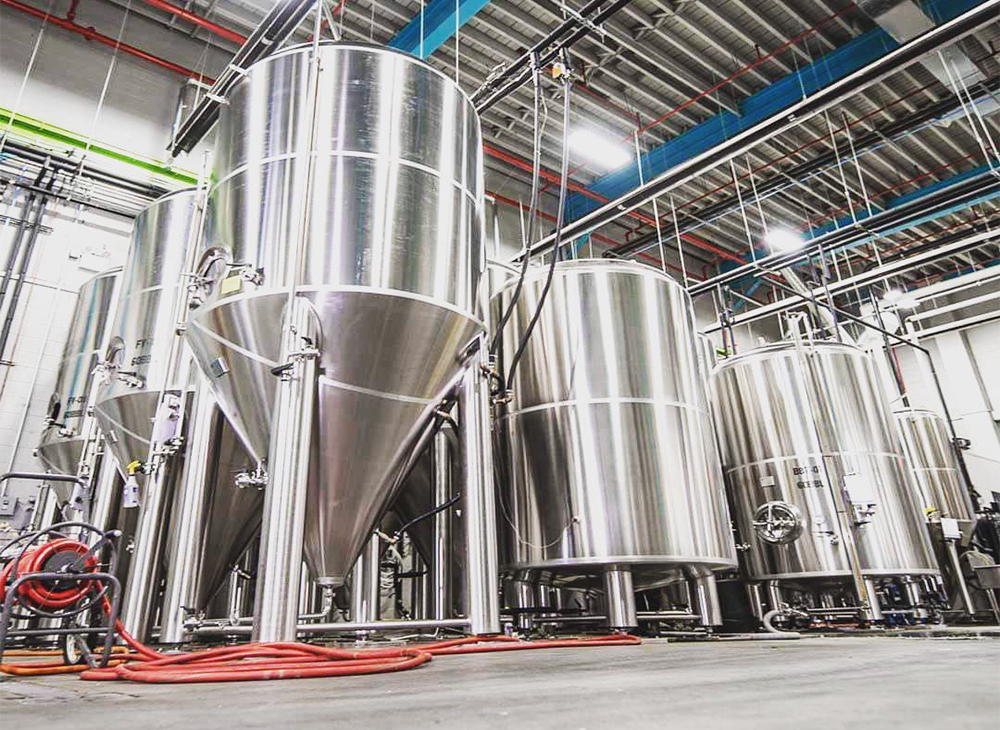
4. Where Are These Valves Installed on Beer Fermentation Tanks?
The installation position depends on the tank design and the manufacturer’s piping arrangement.
Mechanical Blow-Off Valve
The mechanical blow-off valve is generally installed on the upper part of the fermentation tank, connected to the gas outlet or a dedicated pressure-control port.
Its gas discharge line should be designed to allow safe CO₂ release without creating excessive backpressure.
In some brewery configurations, the blow-off assembly may also be connected to a sanitary gas collection or CO₂ recovery system.
Safety Valve
The safety valve is normally installed on the top of the fermentation tank or on a dedicated pressure protection connection.
It should have a direct and reliable connection to the tank’s internal pressure space. Its discharge arrangement must not restrict the required relieving capacity.
The safety valve should be accessible for inspection, testing, and maintenance.
The discharge should be directed to a safe location, taking into account the risk of CO₂ accumulation and personnel exposure.
5. Can a Beer Fermentation Tank Use Both Valves?
Yes. In fact, using both devices is a common approach for pressure-rated beer fermentation tanks.
Each valve performs a different role:
- The mechanical blow-off valve manages routine fermentation pressure.
- The safety valve provides independent protection against excessive pressure.
For example, assume a fermentation tank has a maximum allowable working pressure of 2.0 bar.
The brewery may select a mechanical blow-off valve with a working pressure setting suitable for the fermentation process, while the safety valve is selected and set according to the tank’s approved pressure protection design.
The actual settings must be determined by the tank designer and verified against the applicable pressure vessel code. The safety valve setting must never exceed the tank’s permitted pressure.
This arrangement provides both process flexibility and pressure safety.
6. What Should Breweries Consider When Selecting These Valves?
When purchasing beer fermentation tanks, breweries should pay attention to the following factors:
1. Tank Design Pressure
The design pressure and maximum allowable working pressure of the fermentation tank determine the requirements for pressure protection components.
2. Fermentation Pressure Requirements
Different beer styles and fermentation recipes require different pressure conditions. The mechanical blow-off valve should provide an appropriate adjustment range.
3. Material and Hygienic Design
Valve components in contact with beer or process gas should use suitable food-contact materials, such as stainless steel 304 or 316L, depending on the application.
Sealing materials should be compatible with brewery cleaning and sanitizing procedures.
4. Cleaning and Maintenance
The valve design should allow convenient inspection, cleaning, and maintenance. Dead spaces and areas where beer residues can accumulate should be minimized.
5. Pressure Vessel Compliance
The safety valve must be correctly sized, certified where required, and installed in accordance with the applicable pressure vessel regulations.
It is also important to ensure that no isolating valve or other obstruction can unintentionally block the safety valve’s connection to the tank.
7. TIANTAI Brewtech: Reliable Pressure Control Solutions for Beer Fermentation Tanks
At TIANTAI Brewtech, we understand that fermentation tank accessories are just as important as the tank body itself.
A properly designed pressure-control system helps breweries achieve stable fermentation conditions while protecting equipment and operators.
When designing and manufacturing beer fermentation tanks, TIANTAI considers:
- Appropriate mechanical blow-off valve selection according to fermentation requirements.
- Correct safety valve selection according to tank design pressure and applicable regulations.
- Hygienic stainless steel construction and suitable sealing materials.
- Convenient installation, inspection, and maintenance.
- Integrated pressure-control and gas-discharge arrangements.
Whether you are building a craft brewery, a commercial beer production facility, or an industrial brewery, TIANTAI Brewtech can provide customized fermentation tank solutions according to your production capacity, beer styles, automation requirements, and local pressure vessel standards.

Conclusion
The mechanical blow-off valve and safety valve may look similar, but they serve two different purposes in a beer fermentation tank.
The mechanical blow-off valve is mainly responsible for routine fermentation pressure regulation, while the safety valve is designed to protect the tank against dangerous overpressure conditions.
For a properly engineered pressure-rated fermentation tank, these two components should work together as part of a complete pressure management and protection system.
Choosing the correct valves is not only important for beer fermentation performance but also essential for brewery equipment safety and long-term reliability.
Contact TIANTAI Brewtech to learn more about our customized beer fermentation tanks and complete brewery equipment solutions.
Daisy Email: [email protected]