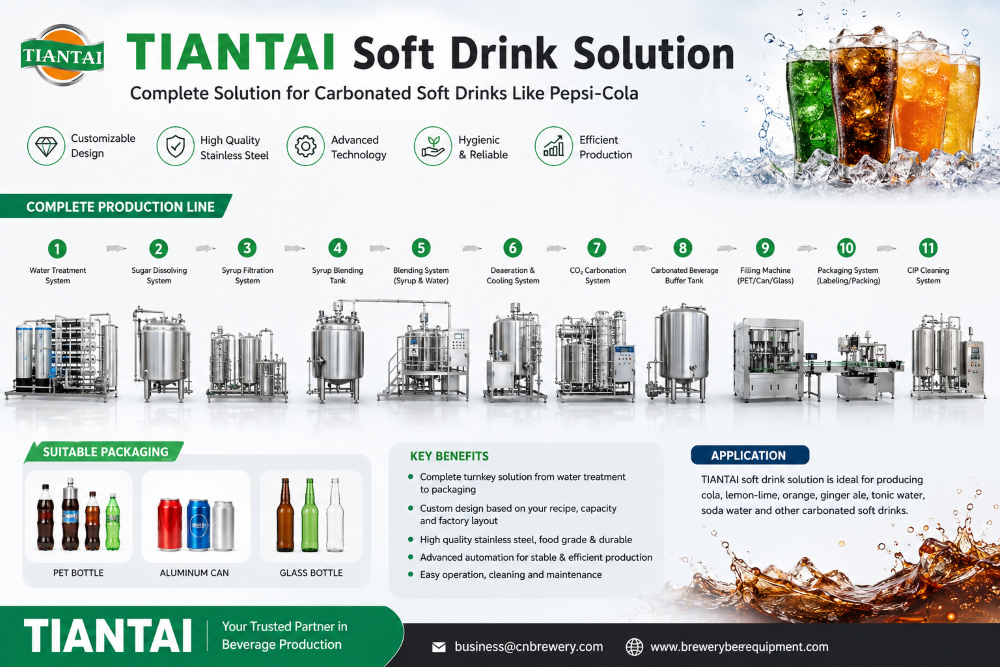
The global demand for cola and other carbonated soft drinks continues to create opportunities for beverage manufacturers, distributors, and private-label brands. For companies planning to produce a Pepsi-Cola-style cola beverage, the key challenge is not simply adding CO₂ to water. A successful production line must achieve consistent water quality, accurate syrup preparation, precise blending, effective carbonation, hygienic processing, and reliable filling.
TIANTAI provides integrated beverage-processing solutions covering these stages—from water treatment and syrup preparation to carbonation and final packaging.
1. What Is a Pepsi-Cola-Style Beverage?
A cola-style carbonated soft drink is generally produced from several key components:
- Treated water
- Sugar or other sweetener
- Cola flavor concentrate
- Food-grade acidulants
- Color
- Caffeine, where applicable
- Preservatives, depending on the formulation and local regulations
- Carbon dioxide (CO₂)
The exact formulation of commercial cola brands is proprietary. Therefore, a new beverage producer normally develops its own cola formulation or purchases an approved cola concentrate from a flavor supplier. From an equipment perspective, however, the basic manufacturing process is well established: water treatment → syrup preparation → syrup filtration → final blending → cooling/deaeration → carbonation → filling and packaging.
2. TIANTAI Complete Cola Beverage Process
A typical TIANTAI production concept can be arranged as:
Raw Water
↓
Water Treatment System
↓
RO / UV / Polishing Treatment
↓
Treated Water Tank
↓
Sugar Dissolving System
↓
Sugar Syrup Filtration
↓
Syrup Preparation / Blending Tank
↓
Cola Concentrate + Flavor + Acid + Color Addition
↓
Syrup Storage Tank
↓
Water & Syrup Proportioning / Blending
↓
Deaeration & Cooling
↓
CO₂ Injection / Carbonation
↓
Carbonated Beverage Buffer Tank
↓
PET / Glass Bottle / Can Filling
↓
Capping / Seaming
↓
Labeling & Packaging
This process follows the conventional architecture used for carbonated soft drinks: water treatment, syrup production, compound syrup preparation, blending, carbonation, and filling.
3. Water Treatment: The Foundation of Cola Quality
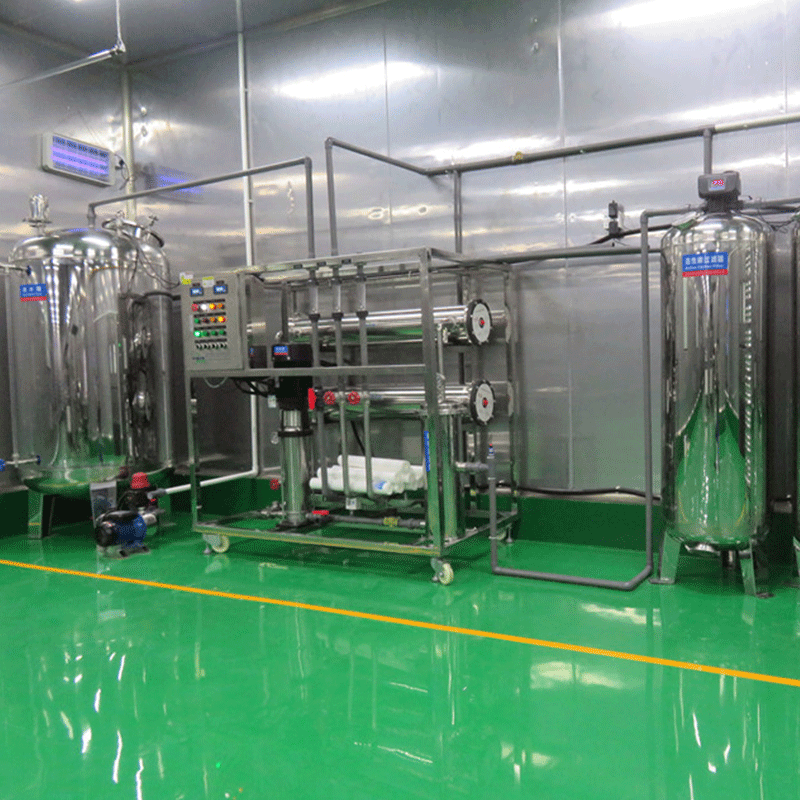
Water is the largest component of most soft drinks. Even when the flavor concentrate is high quality, inconsistent water can cause differences in taste, color, carbonation performance, and product stability. The appropriate water-treatment configuration depends on the customer’s raw-water analysis. A TIANTAI water-treatment system may include:
Typical Configuration
Raw Water Tank
→ Sand Filter
→ Activated Carbon Filter
→ Water Softener
→ 5 μm / 1 μm Filtration
→ RO System
→ UV Sterilizer
→ Polishing Filter
→ Treated Water Tank
Not every project requires every stage. TIANTAI recommends selecting the treatment system based on:
- Raw-water TDS
- Hardness
- Iron and manganese
- Chlorine
- Microbiological quality
- Turbidity
- Local drinking-water standards
- Final beverage formulation
The objective is to create a stable and repeatable water base for the beverage.
4. Sugar Syrup Preparation
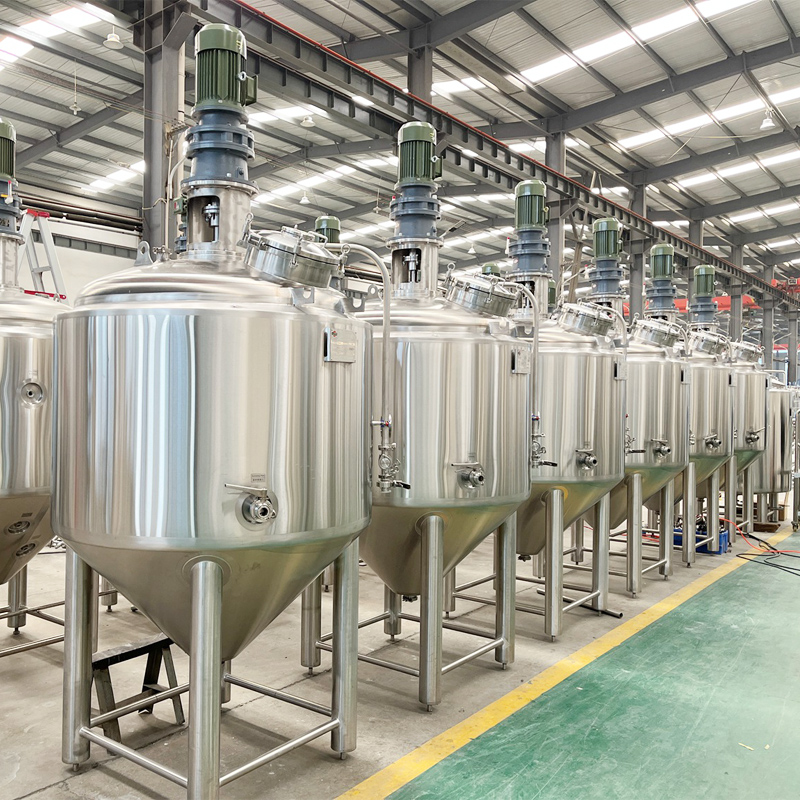
For conventional sugar-sweetened cola, sugar is dissolved in treated water inside a stainless-steel Sugar Dissolving Tank. The system can include:
- Stainless-steel mixing tank
- Agitator
- Steam or hot-water heating
- Temperature sensor
- Level sensor
- CIP spray ball
- Sugar inlet
- Syrup transfer pump
- Syrup filtration system
For larger plants, TIANTAI can design a dedicated automatic sugar dissolving and syrup preparation system. The key objective is not simply dissolving sugar, but achieving: Accurate Brix + complete dissolution + low contamination risk + repeatable batch quality. The syrup can then pass through a filtration system to remove undissolved particles and foreign matter before entering the final formulation stage.
5. Cola Syrup Preparation
This is the heart of the beverage process. After preparing the sugar syrup, the manufacturer combines it with the cola concentrate and other approved ingredients according to its own formulation. A typical syrup preparation tank can include:
- Sugar syrup inlet
- Cola concentrate inlet
- Flavor dosing port
- Acid dosing port
- Color dosing port
- Preservative dosing port, if required
- Agitator
- Load cells or flowmeter
- Temperature measurement
- Brix measurement
- CIP system
TIANTAI Design Philosophy
Rather than simply supplying a mixing tank, TIANTAI can design the syrup system around the customer’s actual recipe and production capacity.
For example: Sugar Syrup Tank → Syrup Filter → Syrup Blending Tank → Syrup Holding Tank
This arrangement gives the operator better control over:
- Brix
- Ingredient ratio
- Batch volume
- Mixing time
- Product temperature
- Recipe repeatability
Syrup formulation is particularly important because flavor, sweetness, acidity, color and other ingredients must be accurately controlled to reproduce the desired beverage profile.
6. Syrup Filtration
Filtration is an important but sometimes overlooked part of a cola production system. Depending on the formulation and process design, TIANTAI can provide:
- Bag filters
- Cartridge filters
- Duplex filters
- Sanitary stainless-steel filters
- Fine polishing filters
The filtration grade should be selected according to the syrup characteristics rather than simply choosing the smallest possible micron rating. A properly designed filtration system helps protect downstream equipment and improves beverage consistency.
7. Syrup and Treated Water Blending
Once the syrup is ready, it needs to be accurately combined with treated water. There are two common approaches:
Batch Blending
Syrup and water are transferred into a blending tank and mixed according to a predetermined recipe.
Advantages:
- Lower initial investment
- Simple operation
- Suitable for small and medium production
- Flexible for multiple beverage recipes
Continuous Blending
Syrup and treated water are continuously metered and mixed using flow-controlled systems.
Advantages:
- Higher production efficiency
- Better automation
- Stable syrup/water ratio
- Suitable for high-capacity production lines
- Reduced manual operation
Continuous proportioning systems use controlled flow rates to maintain the required syrup-to-water ratio. For a high-capacity commercial cola factory, TIANTAI generally recommends an automatic proportioning and blending system.
8. Deaeration and Cooling Before Carbonation
One of the most important engineering considerations is the condition of the beverage immediately before carbonation. Dissolved oxygen can negatively affect beverage quality and can make carbonation more difficult. Therefore, commercial systems may incorporate vacuum deaeration and beverage cooling before CO₂ injection. The process can be:
Blended Beverage
→ Vacuum Deaeration
→ Cooling
→ Carbonation
Cooling improves CO₂ dissolution because CO₂ is more readily absorbed by colder liquid. This is particularly important when the customer wants:
- Stable carbonation
- Low product foaming
- Good filling performance
- Consistent mouthfeel
- Reduced CO₂ consumption
9. CO₂ Carbonation System
After blending and cooling, the beverage enters the carbonation system. TIANTAI can provide a complete carbonation system including:
- CO₂ gas filtration
- CO₂ pressure regulation
- Beverage cooling
- Carbonation mixer
- CO₂ injection system
- Carbonation control
- Pressure control
- Carbonated beverage buffer tank
The CO₂ is dissolved into the beverage under controlled pressure. The final carbonation level should be determined according to:
- Beverage formulation
- Packaging type
- Product temperature
- Filling-machine design
- Target sensory characteristics
- Customer’s product specification
Carbonation is not simply about “adding more CO₂.” Excessive carbonation can create filling problems and excessive foaming, while insufficient carbonation can produce a flat-tasting beverage.
10. Carbonated Beverage Buffer Tank
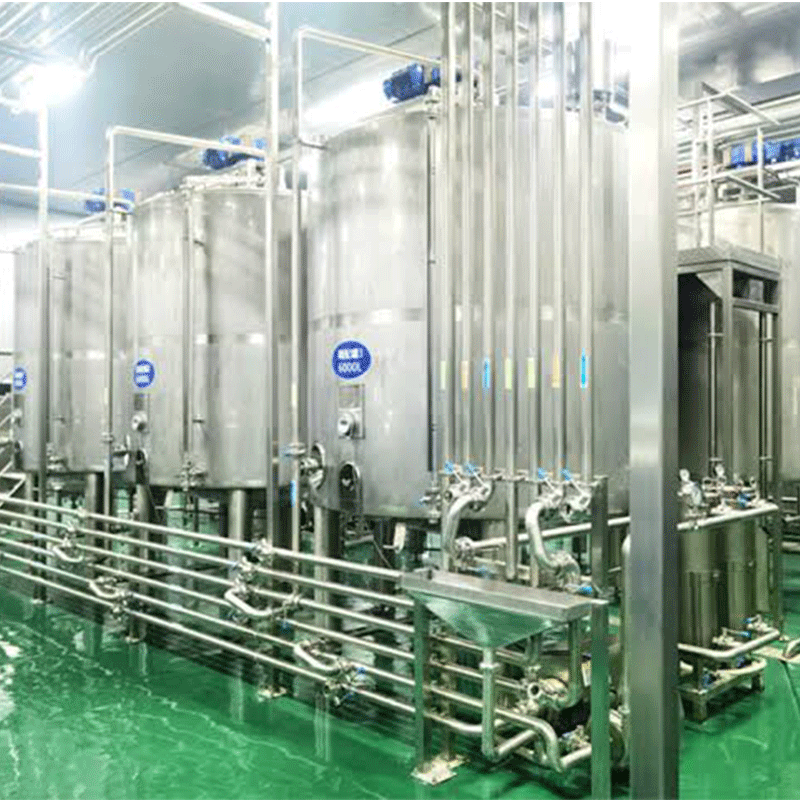
After carbonation, a pressurized carbonated beverage tank can be installed before the filling machine. This tank provides:
- Stable product pressure
- Temporary product buffering
- Continuous supply to the filler
- Reduced pressure fluctuations
- Better coordination between carbonation and filling
For large production lines, this buffer stage is particularly useful because the carbonation system and filling machine may operate at different flow rates.
11. Filling Options: PET, Glass Bottle or Can
TIANTAI can configure the downstream packaging system according to the customer’s target market.
PET Bottle
Typical equipment: Bottle Rinser → Carbonated Beverage Filler → Capper → Labeler → Date Coder → Shrink Wrapper
PET is popular for:
- 250 ml
- 330 ml
- 500 ml
- 1 L
- 1.5 L
- 2 L
Aluminum Can
Typical process: Can Depalletizer → Rinser → Isobaric Can Filler → Seamer → Pasteurization/Inspection if required → Labeling/Packaging
For carbonated cola, counter-pressure/isobaric filling is commonly used because the beverage must be transferred while minimizing CO₂ loss and foaming.
Glass Bottle
Glass bottles can be used for premium cola, restaurants, hotels and returnable-bottle markets.
12. CIP: A Critical Part of the TIANTAI Solution
For commercial soft-drink production, hygienic design is just as important as production capacity. TIANTAI can integrate a dedicated CIP system for:
- Sugar syrup tanks
- Syrup pipelines
- Blending tanks
- Beverage pipelines
- Carbonation system
- Buffer tanks
- Filling machine interfaces
A typical CIP system may include: Caustic Tank → Acid Tank → Hot Water Tank → CIP Pump → Return System The exact CIP procedure and chemical concentration should be validated according to the customer’s equipment, beverage formulation and sanitation program. Because filling and downstream areas can become important contamination points, hygienic equipment design and validated cleaning procedures are essential.
13. Example TIANTAI Cola Production Line
For a medium-scale cola beverage factory, a typical system could include:
| Section | Main Equipment |
|---|---|
| Water Treatment | Sand Filter + Carbon Filter + RO + UV |
| Water Storage | Treated Water Tank |
| Sugar Preparation | Sugar Dissolving Tank |
| Syrup Filtration | Duplex / Cartridge Filter |
| Cola Formulation | Syrup Blending Tank |
| Syrup Storage | Insulated Syrup Tank |
| Blending | Automatic Syrup-Water Blender |
| Deaeration | Vacuum Deaerator |
| Cooling | Beverage Chiller |
| Carbonation | Automatic CO₂ Carbonator |
| Buffering | Pressurized Beverage Tank |
| Filling | PET / Can / Glass Bottle Filler |
| Packaging | Capper/Seamer + Labeler + Packer |
| Cleaning | CIP Cleaning System |
| Control | PLC + HMI Automatic Control |
14. TIANTAI Can Design the System Around Your Production Capacity
One of the biggest mistakes when purchasing a beverage line is selecting equipment only according to the nameplate capacity of the filling machine. The complete process needs to be balanced. For example, if the customer requires 12,000 L/h finished cola beverage, the upstream system must be capable of continuously supplying sufficient:
- Treated water
- Sugar syrup
- Concentrate
- Blended beverage
- Cooling capacity
- CO₂
- CIP capacity
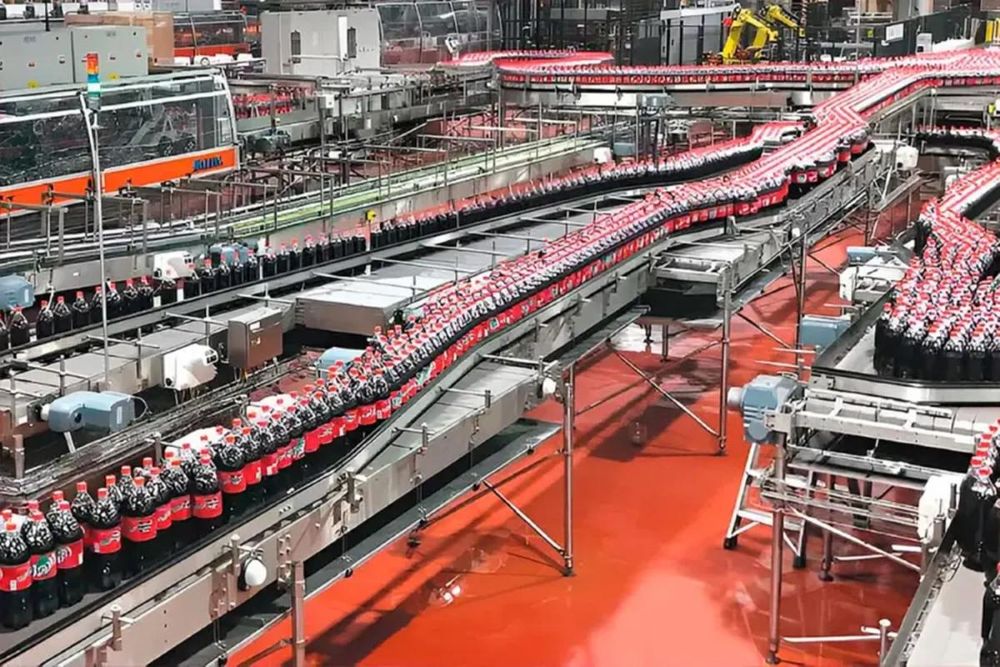
The carbonator, buffer tank and filler must also be properly matched. For example: Water Treatment → Syrup System → Blending → Carbonation → Filling should be designed as one integrated production system rather than as independent machines.
15. How TIANTAI Approaches a Cola Project
TIANTAI does not recommend using one standard configuration for every customer. Before preparing a quotation, we recommend confirming:
Product Information
- Cola or other carbonated beverage?
- Sugar or sugar-free?
- Target Brix?
- Target pH?
- Target carbonation level?
- Flavor concentrate supplied by customer or TIANTAI?
Production Information
- Finished beverage capacity: L/h
- Daily production: L/day
- Working hours/day
- Batch or continuous production
- Number of recipes
Packaging
- PET bottle
- Aluminum can
- Glass bottle
- Bottle/can volume
- Bottles or cans per hour
Utilities
- Raw-water source
- Electricity
- Steam
- Chilled water
- Compressed air
- CO₂ supply
Factory Conditions
- Available production area
- Ceiling height
- Drainage
- CIP requirements
- Existing equipment
This information allows TIANTAI to design a properly balanced beverage-processing system instead of simply quoting individual machines.
16. Why Choose TIANTAI for a Cola Beverage Project?
Complete Process Solution
From water treatment to syrup preparation, blending, carbonation and filling, TIANTAI can integrate the major processing sections into one project.
Customized Capacity
Whether the customer is establishing a small regional beverage plant or a larger commercial production facility, the equipment can be configured according to the required output.
Hygienic Stainless-Steel Design
Product-contact equipment can be designed using sanitary stainless-steel construction, with appropriate fittings, pipelines, valves and CIP provisions.
Flexible Product Development
The same processing platform can potentially be configured for:
- Cola
- Lemon-lime soda
- Orange soda
- Ginger ale
- Tonic water
- Soda water
- Flavored sparkling water
- Energy drinks
- Other carbonated beverages
Automation and Recipe Control
For commercial production, PLC-based control can help operators manage:
- Water dosing
- Syrup dosing
- Mixing
- Temperature
- Brix
- CO₂ pressure
- Production recipes
- CIP procedures
Build a Reliable Cola Beverage Factory with TIANTAI
Producing a Pepsi-Cola-style beverage is fundamentally a precision beverage-processing project. The final product depends on much more than the filling machine. Water quality, syrup preparation, filtration, ingredient dosing, blending accuracy, deaeration, cooling, carbonation and hygienic filling all contribute to the final beverage quality. TIANTAI’s approach is to design the complete process around the customer’s product, capacity, packaging and factory conditions.
From a compact startup cola line to a high-capacity automated carbonated beverage factory, TIANTAI can provide a customized solution covering: Water Treatment → Sugar Syrup → Cola Syrup → Filtration → Blending → Deaeration → Cooling → Carbonation → Buffering → Filling → Packaging → CIP The result is a scalable, hygienic and production-oriented solution designed for consistent beverage quality and practical operation.
TIANTAI — Customized Beverage Processing Solutions from Process Design to Complete Production Line.
Daisy: [email protected]