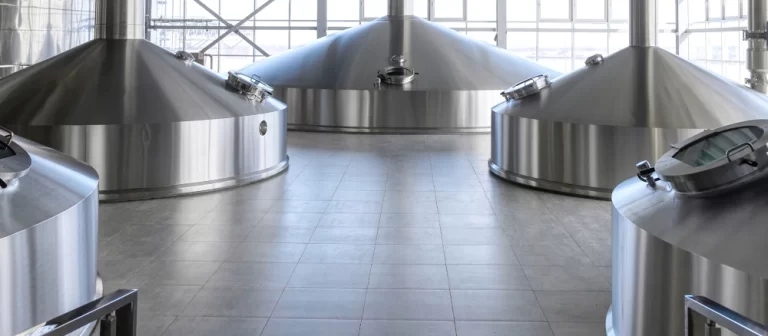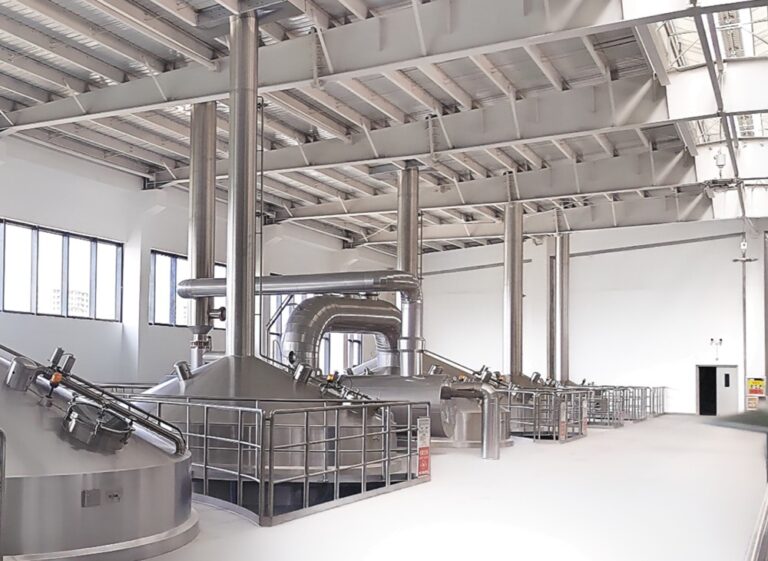
From Malt Grain to Refreshing Carbonated Malt Beverage — Complete Processing, Mixing, Carbonation and Filling Solution. Carbonated malt drinks have become an increasingly attractive category for beverage producers looking to combine the rich flavor of malt with the refreshing character of a carbonated soft drink. Unlike conventional beer, carbonated malt beverages can be developed with different levels of sweetness, acidity, malt flavor, color and carbonation. Depending on the formulation and local regulations, the product can be produced as a non-alcoholic or low-alcohol beverage.
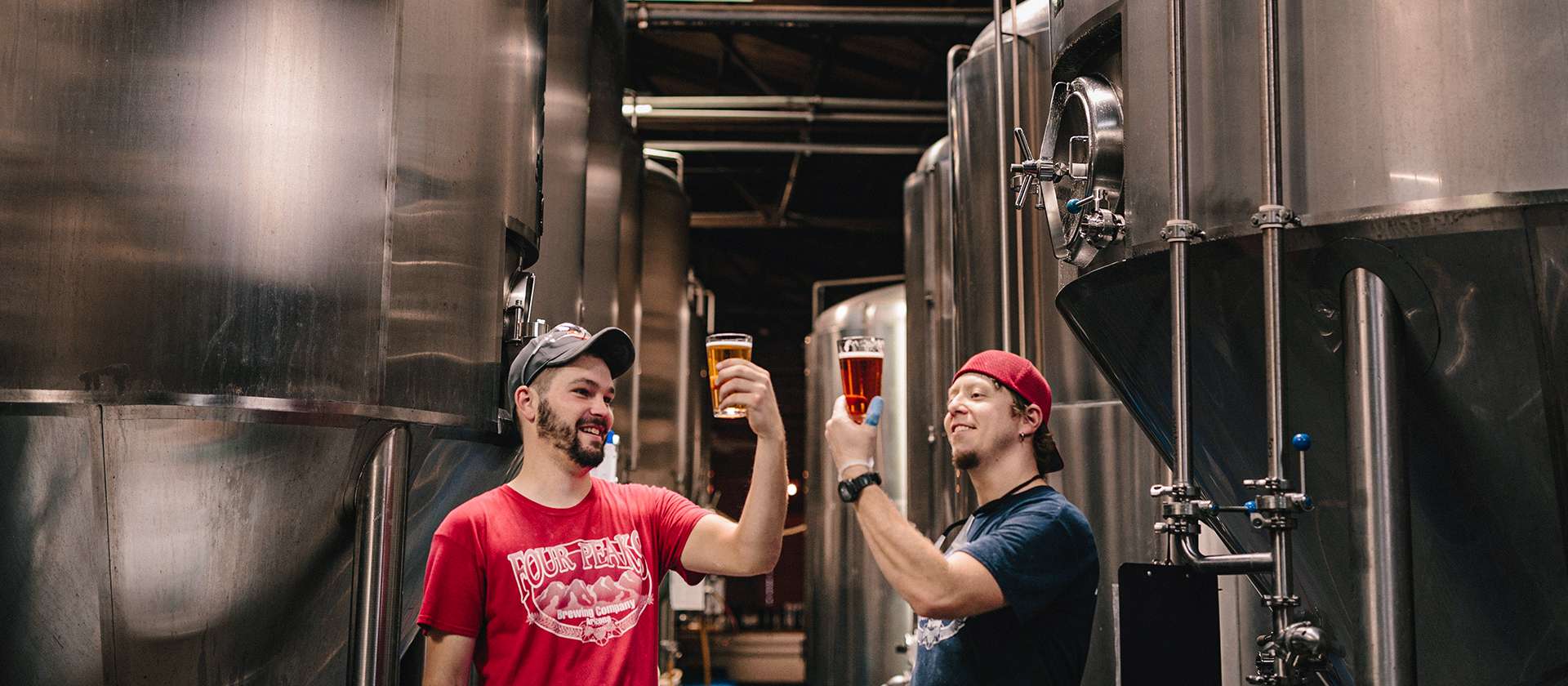
1. What Is a Carbonated Malt Drink?
A carbonated malt drink is a beverage based on malt-derived wort or malt extract and formulated with ingredients such as:
- Malted barley or malt extract
- 양조용 물
- Sugar or liquid sugar syrup
- Hops or hop extract, when required
- Food acids
- Natural or artificial flavors
- Caramel color
- Stabilizers
- 이산화탄소
The final product can range from a traditional malt-flavored beverage to a sweet, fruit-flavored carbonated malt drink. For a non-alcoholic carbonated malt drink, the production process is normally designed to minimize or eliminate alcoholic fermentation. Another approach is controlled fermentation followed by alcohol reduction or dilution, depending on the target product and applicable regulations. In the United States, regulatory classification also depends on the formulation and whether the beverage has undergone alcoholic fermentation, so the product definition should be confirmed for the target market before equipment selection.
2. TIANTAI Carbonated Malt Drink Production Process
For customers using original malt rather than ready-made malt extract, TIANTAI can design a complete process starting from malt milling.
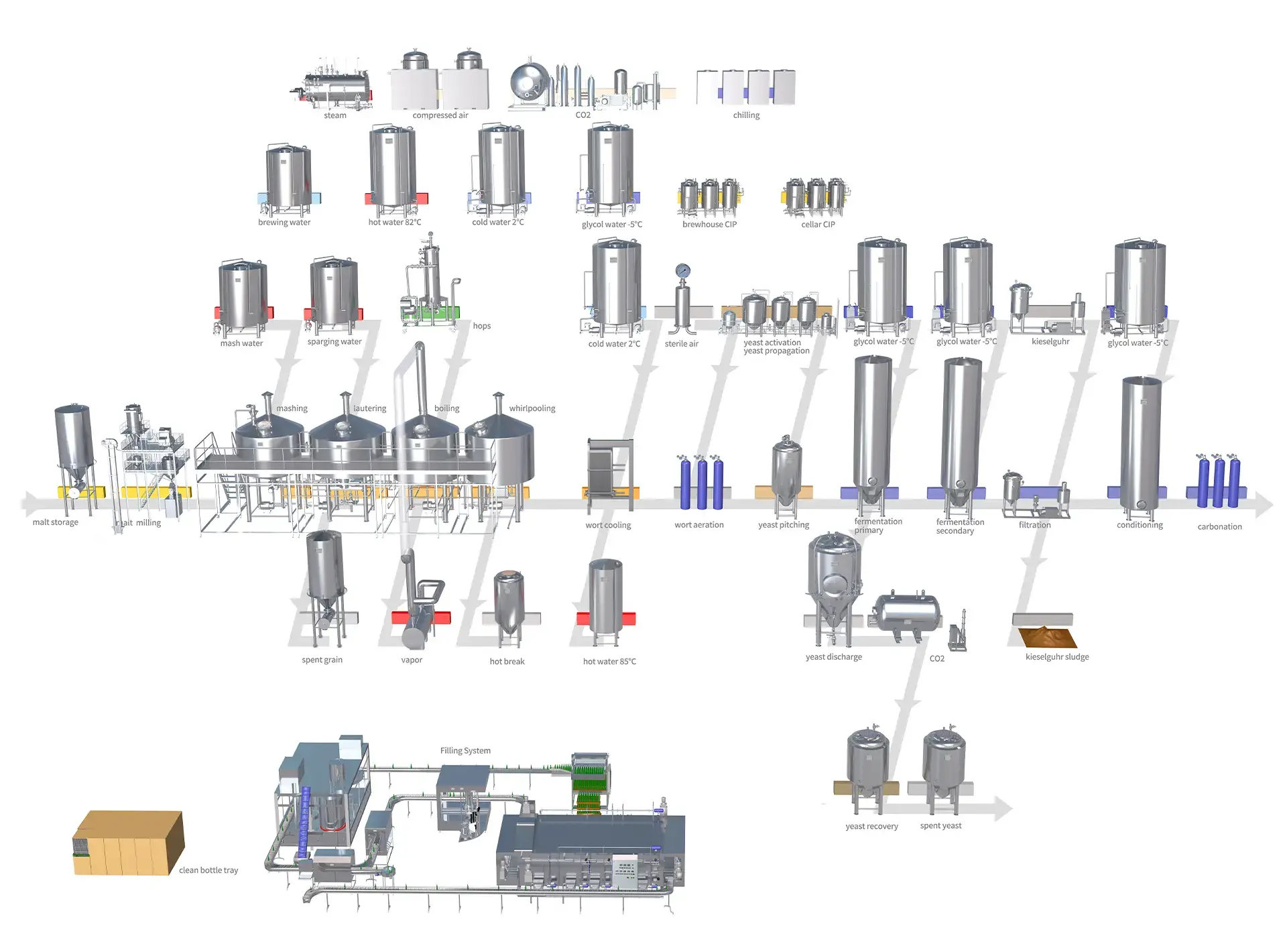
A typical process is: Malt Receiving → Malt Cleaning → Malt Milling → Mashing → Wort Filtration → Wort Boiling → Wort Cooling → Formulation → Filtration/Homogenization → Pasteurization → Cooling → Deaerated Water Mixing → CO₂ Carbonation → Filling → Packaging
For some product formulations, fermentation, yeast separation and maturation can be incorporated into the process.
Simplified Process Flow
Malt → Milling → Mashing → Lautering → Wort Boiling → Wort Cooling → Malt Base Tank → Sugar/Flavor Blending → Filtration → Pasteurization → Cooling → Deaerated Water + CO₂ → Carbonated Malt Beverage → Can/Bottle Filling
This process gives the producer flexibility to manufacture different recipes on the same production platform.
3. Malt Milling — The First Step for Consistent Quality
When the customer uses whole malt, proper milling is extremely important. The objective is not simply to make the malt as fine as possible. The husk should remain sufficiently intact to support efficient wort filtration, while the endosperm should be opened to improve starch conversion. TIANTAI can configure:
- Malt hopper
- Malt cleaning system
- Magnetic separator
- Malt mill
- Dust collection system
- 스크류 컨베이어
- Bucket elevator
- Malt dosing system
For larger projects, the milling system can be integrated with automatic weighing and conveying.
4. Mashing and Wort Production
The milled malt is mixed with hot brewing water inside the mash tun. During mashing, enzymes naturally present in the malt convert starch into fermentable and non-fermentable carbohydrates. Typical process stages can include: Mashing-in → Protein Rest → Saccharification → Mash-out The actual temperature profile should be determined according to the malt specification and desired beverage characteristics. TIANTAI’s brewhouse can be equipped with:
- 매시 툰
- Steam heating system
- 교반기
- Temperature sensors
- Automatic steam control
- 더 보기
- 맥아 즙 펌프
- 뜨거운 주류 탱크
- PLC 제어 시스템
The result is a malt wort with controlled extract, color and flavor.
5. Wort Filtration and Boiling
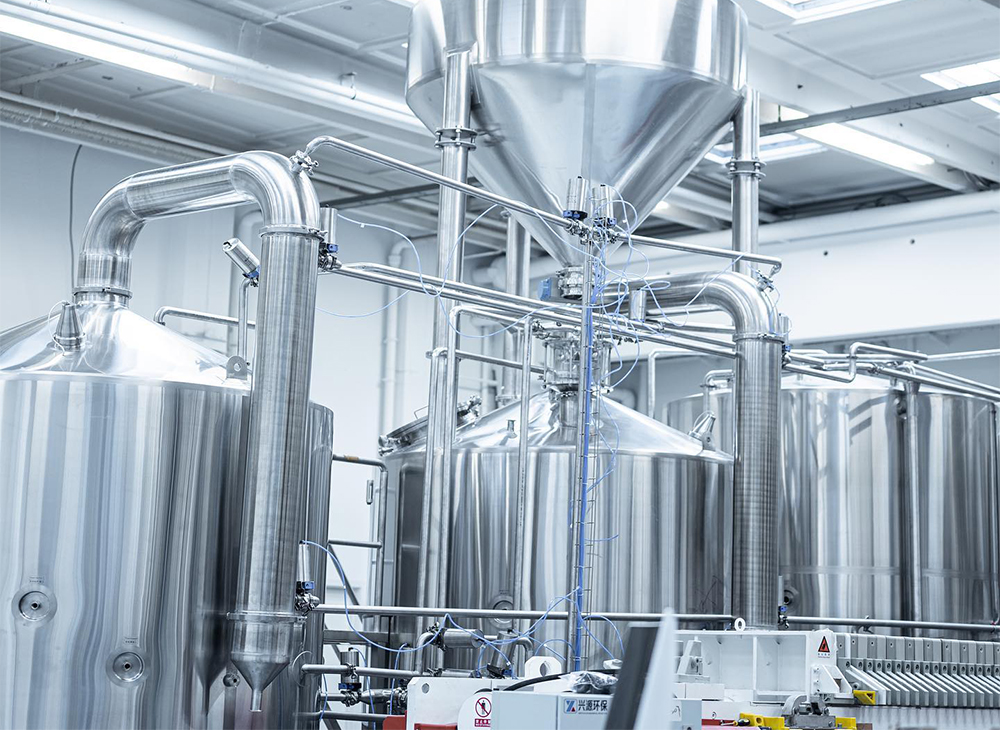
After mashing, the mash enters the lauter tun. The lauter tun separates: Clear wort + spent grain Hot water can be used for sparging to recover additional soluble extract from the grain bed. Depending on the recipe, the wort may then enter a wort kettle for controlled heating and sterilization. For a carbonated malt beverage, the boiling process can be designed differently from a conventional beer brewing process because the final product may not require the same hop profile or bitterness. TIANTAI therefore designs the brewhouse according to the actual malt beverage recipe rather than simply copying a conventional beer brewhouse.
6. Malt Base Preparation
After wort production, the malt base can be transferred to a dedicated processing or blending tank. This is where the beverage producer can adjust:
- Extract concentration
- Malt flavor
- 색상
- Sweetness
- 산도
- Flavor profile
- Final beverage strength
For example, a sweet carbonated malt drink may contain sugar syrup, while a flavored malt drink may contain fruit flavor, lemon flavor, ginger, cola flavor or other ingredients. A dedicated Sugar Syrup Preparation System can be installed for large-scale production. Typical equipment includes: Sugar Dissolving Tank → Sugar Syrup Filter → Syrup Storage Tank → Metering Pump → Blending Tank
7. Formulation and Blending System
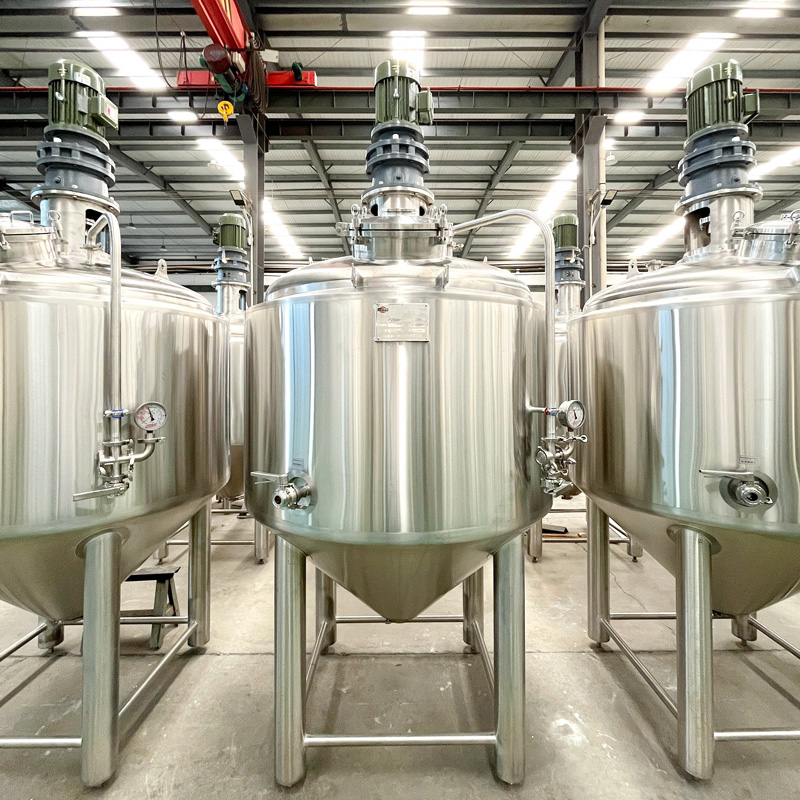
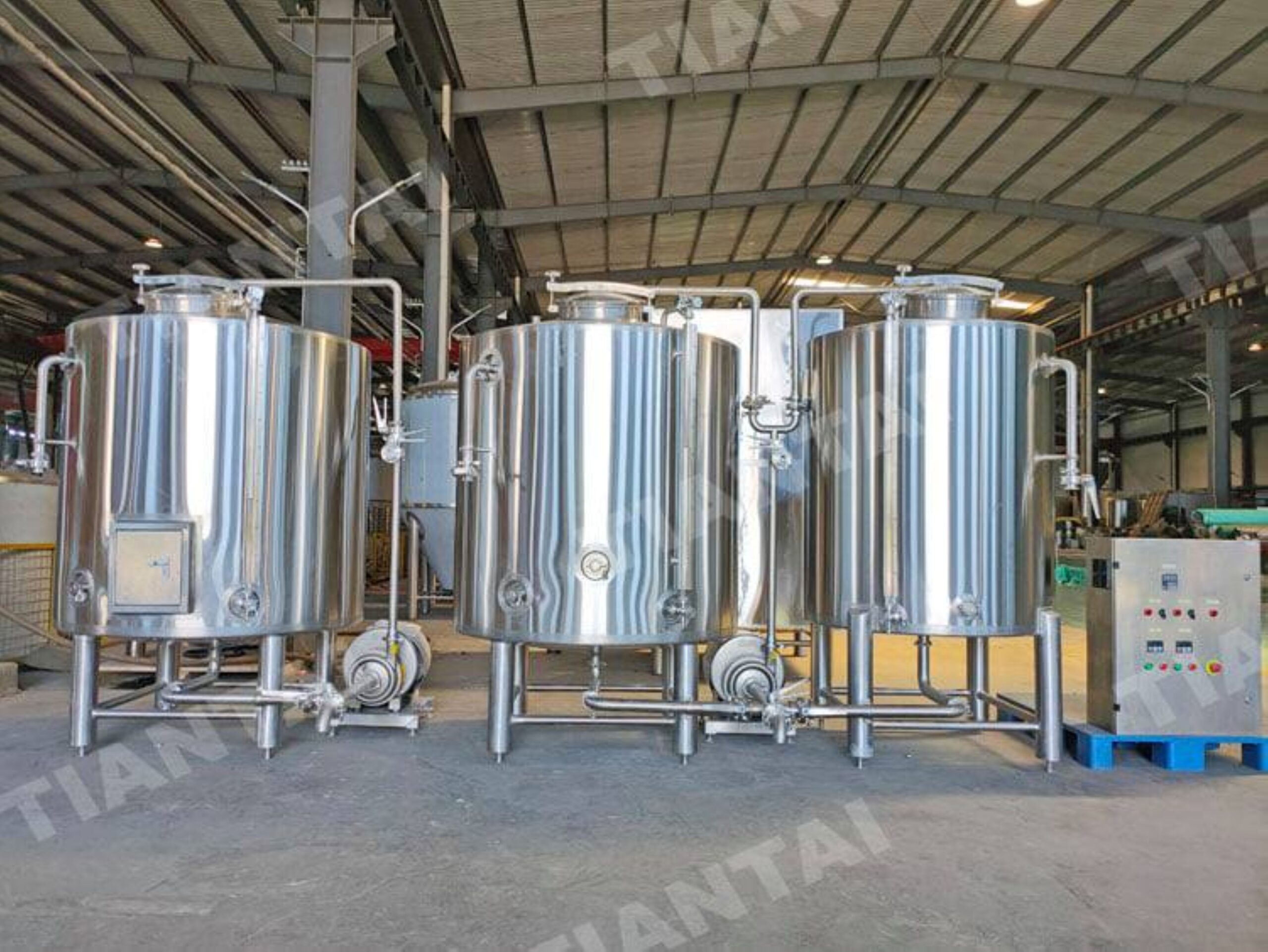
The formulation stage is one of the most important parts of a carbonated malt drink production line. A typical blending tank can receive:
- Malt base
- 설탕 시럽
- Treated water
- Acid solution
- 맛
- 색상
- Stabilizer
TIANTAI can provide automatic dosing systems so that each production batch follows a predefined recipe. This is particularly useful for producers manufacturing multiple SKUs.
예를 들어
Malt Original
Malt + Lemon
Malt + Ginger
Malt + Cola
Malt + Fruit Flavor
The same production system can be designed to handle different formulations with recipe management through a PLC/HMI control system.
8. Why Deaerated Water Is Important
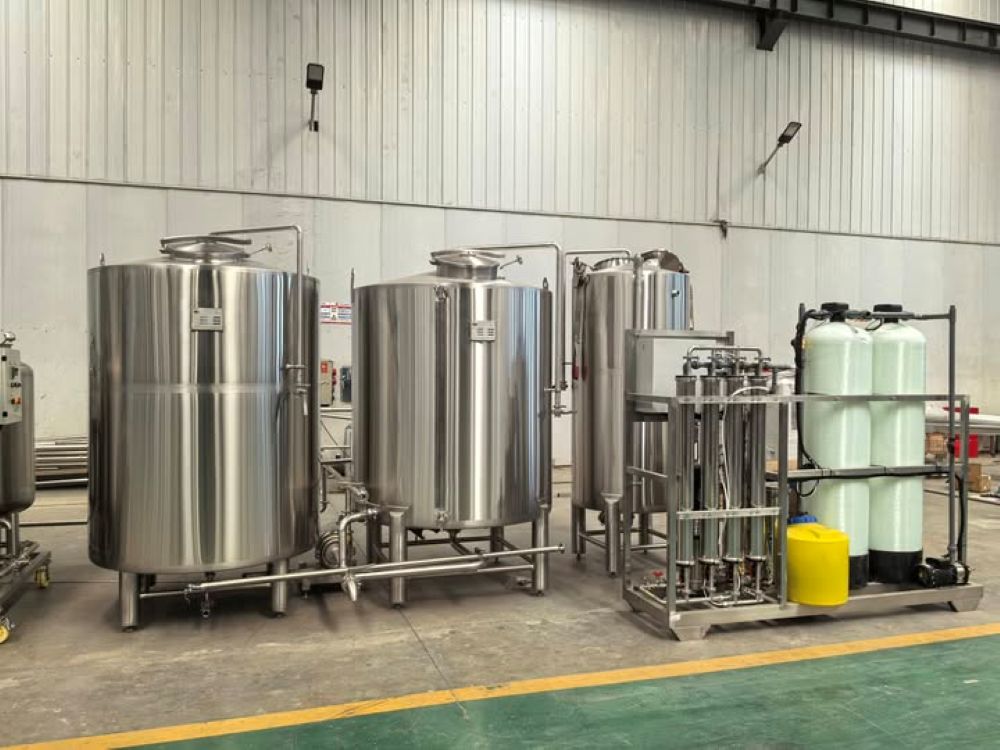
For carbonated malt beverages, water quality is critical. TIANTAI can integrate: Raw Water → Pretreatment → RO System → Water Storage → Deaeration → Carbonated Beverage Mixing Deaerated water helps reduce dissolved oxygen before carbonation and blending. This is especially important for products where flavor stability, color retention and shelf life are critical. For high-capacity production lines, TIANTAI can design the water treatment and deaeration system according to the required beverage output.
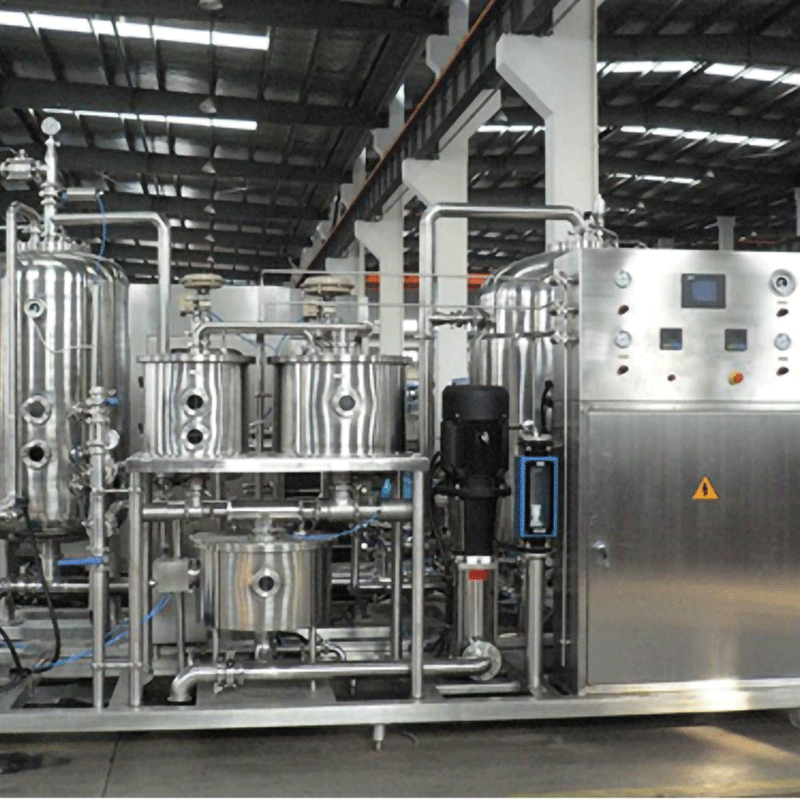
9. CO₂ Carbonation System
Carbonation gives the malt drink its characteristic refreshing mouthfeel. A typical system consists of: CO₂ Storage/Supply → CO₂ Filtration → Deaerated Water → Beverage Mixer/Carbonator → Carbonated Malt Beverage The carbonation system must be designed according to:
- Beverage flow rate
- CO₂ volume requirement
- Product temperature
- CO₂ 압력
- Packaging format
- Filling machine capacity
For example, a high-speed canning line may require a continuous inline carbonator rather than a small batch carbonation tank. TIANTAI can therefore match the carbonation system directly with the downstream filling line.
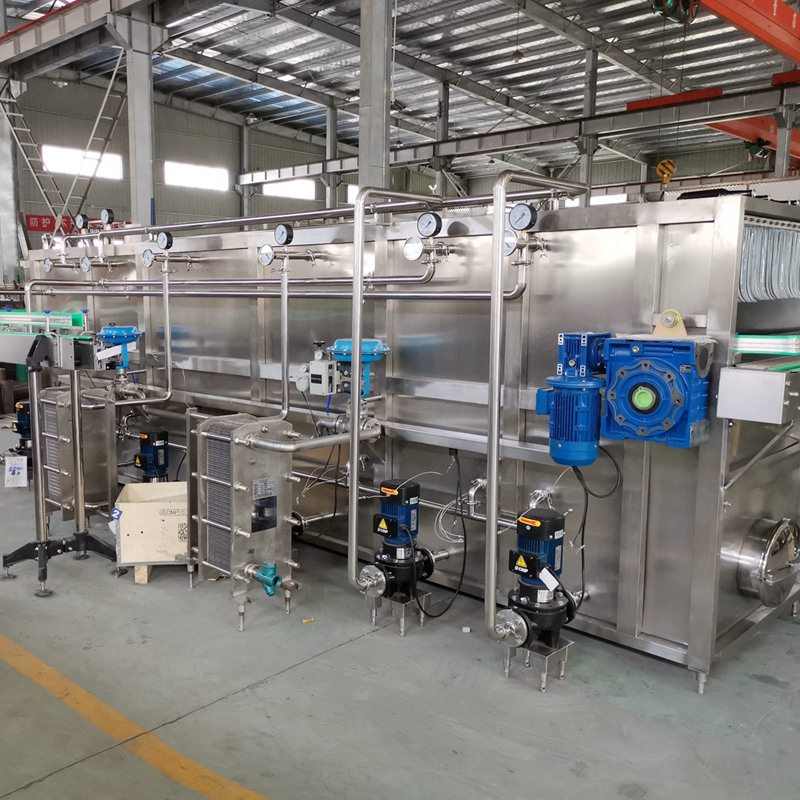
10. Pasteurization — Flash Pasteurization or Tunnel Pasteurization?
This is an important question when designing a carbonated malt beverage plant. There are two common approaches.
Option 1: Flash Pasteurization
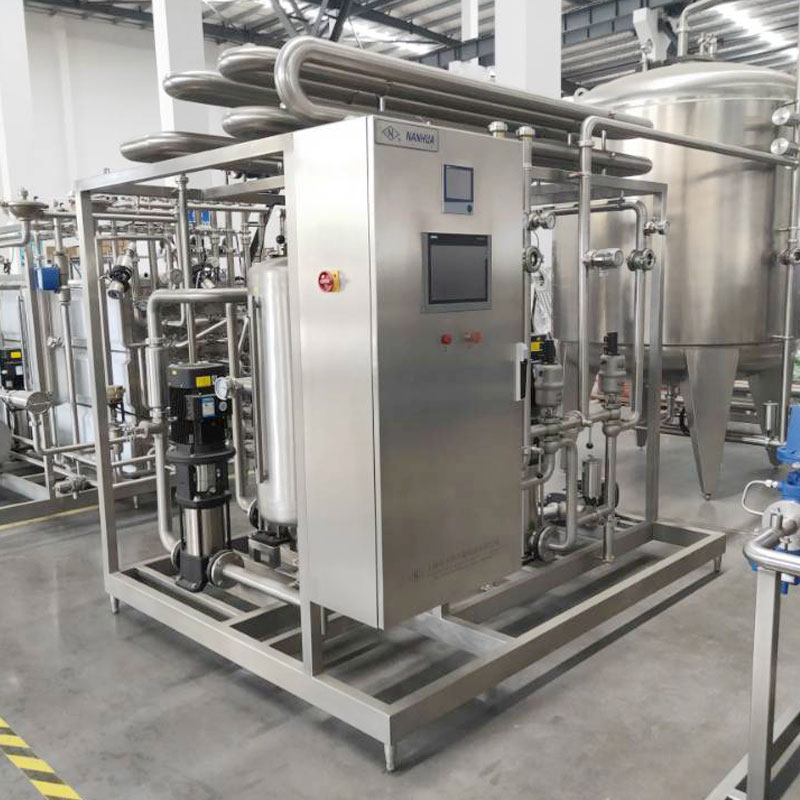
The beverage is rapidly heated, held for a controlled period and then cooled before filling.
일반적인 장비: Plate Heat Exchanger → Holding Tube → Cooling Section
다음과 같은 이점이 있습니다:
- Short thermal exposure
- High production efficiency
- 지속적인 운영
- Better control of processing conditions
Option 2: Tunnel Pasteurization
The product is filled and sealed first, then passed through a pasteurization tunnel.
다음과 같은 이점이 있습니다:
- Suitable for many bottle/can products
- Final package pasteurization
- Useful for products requiring additional post-fill microbiological stability
The appropriate solution depends on the product formulation, packaging material, filling technology and required shelf life. TIANTAI can design either system or combine different thermal treatment strategies according to the customer’s process.
11. Homogenization and Filtration
Some carbonated malt drinks contain flavor oils, emulsions, proteins or suspended ingredients. In these cases, a homogenizer may be required to improve product uniformity.
A typical system may include: Blending Tank → Pre-filter → Homogenizer → Fine Filtration → Pasteurizer Not every malt beverage requires high-pressure homogenization. TIANTAI recommends it when the formulation requires improved emulsion stability or suspension uniformity.
12. Carbonated Malt Beverage Filling
After carbonation, the beverage is transferred to the filling machine under controlled pressure. Depending on the packaging format, TIANTAI can integrate:
캔
- Can rinser
- Isobaric counter-pressure filler
- Seamer
- Pasteurization tunnel, if required
- Can dryer
- Date coder
- Labeler or shrink wrapper
- Carton packing
유리 병
- 보틀 헹굼기
- Counter-pressure filler
- Crown capper
- Pasteurization tunnel
- 라벨 제작기
- Packaging machine
페트병
- 병 헹굼
- 역압 충전
- 제한
- 라벨링
- Shrink wrapping
For high-speed carbonated beverage production, the filler must be properly matched with the carbonation system to minimize CO₂ loss and foaming.
13. Example: 24,000 CPH Carbonated Malt Drink Line
For a customer producing 250 ml slim cans at 24,000 cans/hour, the theoretical filling capacity is: 24,000 × 0.25 L = 6,000 L/hour
Therefore, the downstream filling line handles approximately: 6,000 L/h of finished beverage
The upstream processing system should normally be designed with sufficient capacity and buffer volume to maintain continuous filling. A typical configuration could include:
| Section | Main Equipment |
|---|---|
| Malt Handling | Malt Hopper + Cleaner + Mill |
| 양조 | Mash Tun + Lauter Tun + Wort Kettle |
| Wort Handling | Wort Pump + Heat Exchanger |
| Formulation | Malt Base Tank + Mixing Tank |
| Sugar System | Sugar Dissolving Tank + Syrup Filter |
| Water System | RO + Water Tank + Deaerator |
| 블렌딩 | Automatic Mixing System |
| 필터링 | Cartridge/Polishing Filter |
| Thermal Treatment | 플래시 저온 살균기 |
| 탄산 | Inline CO₂ Mixer/Carbonator |
| 채우기 | 24,000 CPH Can Filler & Seamer |
| 패키징 | Warmer/Tray Packer/Shrink Wrapper |
| 청소 | Automatic CIP System |
| 유틸리티 | Steam Boiler + Chiller + Air Compressor + CO₂ System |
The actual tank sizes and capacities should be calculated according to daily production hours, batch size, filling speed, cleaning time and buffer requirements, rather than simply selecting every machine according to the nominal filler speed.
14. TIANTAI’s Engineering Approach
A successful carbonated malt beverage project is not simply a collection of individual machines. The most important part is the integration between processes. TIANTAI focuses on:
① Complete Process Design
From malt milling to final packaging, the complete process is considered before equipment selection.
② Flexible Recipe Production
One system can be configured to produce different flavors and formulations.
③ Hygienic Stainless-Steel Construction
Product-contact components can be manufactured using food-grade stainless steel, with sanitary piping and fittings selected according to the application.
④ Automated Production
PLC + HMI control can manage:
- 온도
- Flow
- Tank level
- 펌프 작동
- Valve switching
- 레시피 관리
- CIP programs
- Pasteurization parameters
- Carbonation parameters
⑤ CIP Cleaning
A complete CIP system can be integrated for:
Pre-rinse → Caustic Cleaning → Intermediate Rinse → Acid Cleaning → Final Rinse
This is essential for maintaining hygienic production and reducing manual cleaning requirements.
⑥ Utility Integration
TIANTAI can also calculate and integrate:
- 증기 보일러
- 냉각기
- Cooling water system
- 압축 공기
- CO₂ supply
- RO water treatment
- Electrical control system
- CIP 시스템
15. Why Choose TIANTAI for a Carbonated Malt Drink Project?
TIANTAI provides more than individual tanks or machines. We provide a complete engineering solution based on the customer’s:
- 생산 능력
- Product formulation
- Packaging format
- Target market
- Factory space
- Utility conditions
- Automation requirements
- 예산
- Future expansion plan
계획 중인지 여부 small pilot carbonated malt beverage plant, a medium-sized commercial production line, or a 24,000 CPH high-speed canning line, TIANTAI can develop the process flow, equipment configuration, tank sizing and utility requirements for the complete project.

최종 생각
The key to producing a successful carbonated malt drink is not simply adding CO₂ to malt wort. A commercially successful product requires careful control of: Malt Extraction + Formulation + Water Quality + Oxygen Control + Thermal Treatment + Filtration + Carbonation + Filling A properly engineered system can provide consistent flavor, stable carbonation, reliable shelf life and efficient production.
TIANTAI Carbonated Malt Drink Production System integrates brewing technology, beverage processing, carbonation and filling technology into one complete solution—helping beverage producers move from raw malt to finished packaged carbonated malt drinks with a scalable and commercially practical production system.
TIANTAI — Your Partner for Complete Beverage Production Solutions.
데이지: [email protected]