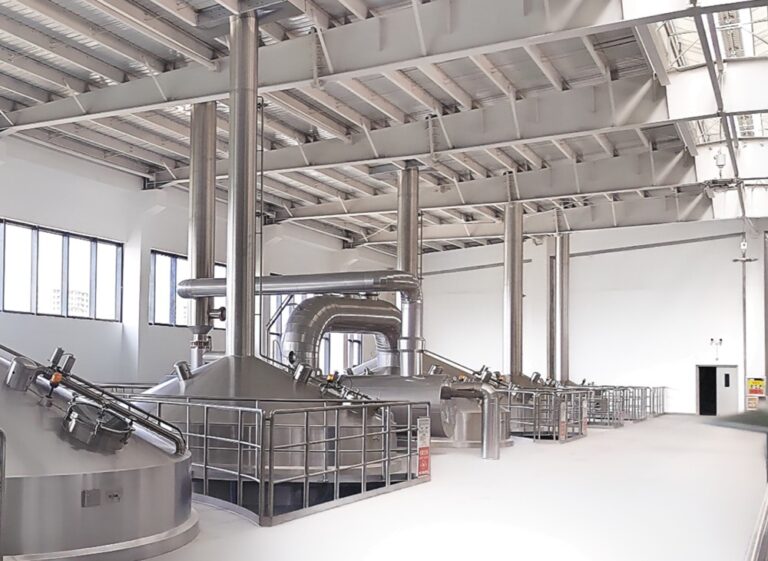
African Chibuku beer is a traditional opaque beer mainly produced from sorghum, maize, water, and fermentation cultures. Unlike conventional clear lager beer, Chibuku has a thick texture, cloudy appearance, slightly sour flavor, and relatively short fermentation cycle. With increasing demand for traditional African beverages, modern Chibuku beer brewing equipment is helping producers achieve larger production capacity, better hygiene, and more consistent product quality.
완전한 Chibuku beer production line normally includes raw material handling, milling, mashing, cooking, fermentation, blending, pasteurization, and packaging equipment.


1. Grain Cleaning and Milling Equipment
The first step in sorghum beer brewing is preparing the raw materials. Sorghum and maize must be cleaned to remove dust, stones, metal particles, and other foreign materials.
The main equipment includes:
- Grain cleaner
- 자력 분리기
- Grain storage hopper
- Hammer mill or roller mill
- Grain conveying system
The grains are milled into suitable flour or grits before entering the brewing process.
2. Mash Cooker and Mashing Tank
Maize and sorghum contain large amounts of starch. Therefore, a mash cooker is required to heat and gelatinize the starch.
A typical African traditional beer equipment system includes a steam-heated cooking tank with an agitator. The agitator ensures uniform heating and prevents materials from settling or burning.
After cooking, malted sorghum may be added to provide natural enzymes for starch conversion. A properly designed sorghum brewing equipment system allows accurate temperature control during this important process.
3. Cooling Equipment
After mashing and cooking, the hot mash must be cooled to the required fermentation temperature.
A plate heat exchanger or tubular heat exchanger can be used for cooling. The cooling system may also include:
- 글리콜 물 탱크
- 냉각기
- Cooling pumps
- 온도 제어 시스템
Efficient cooling is essential for stable fermentation and product quality.
4. Chibuku Beer Fermentation Tanks
Fermentation is one of the most important stages in opaque beer production. The cooled mash is transferred into stainless steel fermentation tanks, where yeast and fermentation cultures convert sugars into alcohol and organic acids.
현대적인 Chibuku beer fermentation tanks are normally equipped with cooling jackets, temperature sensors, pressure control devices, CIP cleaning systems, and sanitary valves.
Depending on the production recipe, fermentation may take from one to several days.
5. Blending and Storage Tanks
After fermentation, the product may be transferred to blending tanks for final adjustment.
Blending equipment allows producers to control:
- Alcohol content
- 산도
- 제품 일관성
- 맛
- Final volume
Because Chibuku is traditionally cloudy, complete filtration is generally unnecessary. The suspended solids are an important feature of traditional African beer production.
6. Pasteurization Equipment
For commercial-scale production, pasteurization may be required to improve microbiological stability and extend shelf life.
A flash pasteurizer or tunnel pasteurizer can be integrated into the industrial Chibuku beer production line, depending on the production capacity and packaging method.
7. Filling and Packaging Equipment
The final Chibuku beer can be packed in PET bottles, cartons, plastic containers, or pouches.
A complete filling line may include:
- Container rinsing machine
- 충전 기계
- 캡핑 머신
- 라벨 제작기
- Date coding machine
- Carton packaging system
결론
완전한 Chibuku beer brewing equipment system includes grain milling, mash cooking, mashing, cooling, fermentation, blending, pasteurization, and packaging equipment. Modern African beer brewing equipment can improve production efficiency while maintaining the traditional taste and characteristics of Chibuku beer.
For investors planning a commercial project, selecting professional sorghum beer brewing equipment is essential for achieving reliable, hygienic, and large-scale Chibuku production.
If you are interested in any Chibuku beer brewery equipment, please feel free to contact us:
아이비 량(영업 이사)
이메일: [email protected]